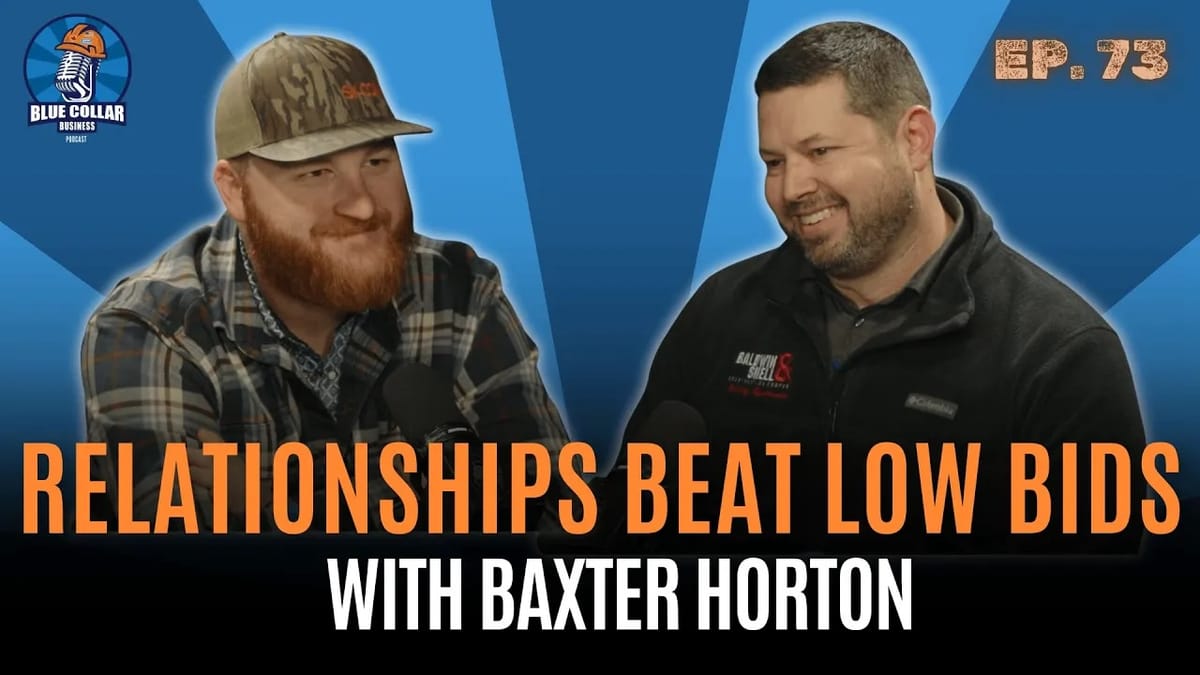
Want to know how general contractors decide which subs to trust with real commercial work? We sit down with Baxter Horton, Director of Pre-Construction at Baldwin Shell, to open the black box of estimating, pre-con, and risk management in a way most folks never get to hear. Baxter’s path from trade partner to GC gives him a rare perspective on what actually wins a bid: clear scope, financial readiness, honest conversations, and a schedule you can defend.
We talk through the jump from residential to commercial and why cash flow can make or break that first project. Baxter explains how GCs level bids, why detailed proposals on letterhead matter, and what to include in your inclusions, exclusions, and assumptions so a reviewer can select you with confidence. We cover bonding limits, insurance requirements, 30-60-90 terms, and how to build cost codes that let you justify production and protect your margin. If you’ve ever wondered why “we do everything” turns a GC off, this is your blueprint to speak their language.
You’ll learn practical ways to bring value beyond being low: flagging scope gaps like roof drain tie-ins, aligning civil and plumbing drawings, proposing alternates that cut weeks off the schedule, and documenting the savings in time and general conditions. We dig into communication cadence, how to ask for feedback after a loss, and when to stop investing in contractors who won’t value your detail. Baxter also shares Baldwin Shell’s footprint across Arkansas, the types of projects they build, and why they’re hiring estimators and pre-con managers who think like problem solvers, not price relayers.
If you’re a subcontractor aiming to get that first commercial win, or a young estimator looking to build a career in preconstruction, this conversation gives you the tactical playbook: know your costs, manage risk on paper before dirt moves, and play the long game with partners who value clarity and trust.
Subscribe, share with a teammate who bids, and leave a review telling us the one change you’ll make on your next proposal.
Follow and stay connected:
Never miss an update—follow, subscribe, and join the conversation!
More About this Episode
Why Storytelling is the Most Underrated Tool in the Blue-Collar Industry
In the world of dirt, pipe, and steel, to those of us who make our living with boots on the ground and grit in our teeth, storytelling probably isn't the first tool we think about when we reach for something to help build our business. Excavators? Check. GPS-grade control? Check. A reliable crew? Check.
But storytelling?
Most blue-collar business owners, myself included for a long time, never put storytelling in the same category as the essentials. But if you’re building something to last, something to pass on, something that actually moves the needle in your community, your team, and even your industry... storytelling might be the most overlooked, underutilized, and powerful tool in the blue-collar toolbox.
The Evolution of Dirt World Media
I recently had the honor of sitting down with Aaron Witt, founder of BuildWitt and the Dirt World Summit, for what turned out to be one of the most eye-opening conversations I've had around marketing, leadership, and purpose in our industry. Aaron has spent the better part of a decade documenting the stories behind the infrastructure we all help build. Not the flashy equipment walk-arounds or highlight reels, but the people, the processes, and the purpose behind this work.
Aaron didn’t grow up blue-collar, but he found himself on a pipe crew in Phoenix at 18 and was hooked. Since then, he’s not just been building a company, he's been building a movement.
His early days of telling stories through blogs, social posts, and eventually a podcast (now with over 350 episodes) laid the groundwork for what’s now known as the Dirt World Movement: a collective push to bring respect, visibility, and pride back to the trades by telling better stories.
Breaking Into Commercial Construction: What Every Subcontractor Needs to Know Before Making the Jump
Commercial construction is often seen as the holy grail for blue-collar subcontractors. The contracts are bigger, the projects are more prestigious, and for many, it represents the next level of business growth. But what does it really take to go from residential or light commercial into the high-stakes world of commercial construction, and more specifically, to build a relationship with a general contractor (GC) that can be sustained over the long haul?
That was the heart of the conversation in this episode of the Blue Collar Business Podcast, where I sat down with Baxter Horton, Director of Preconstruction at Baldwin & Shell Construction Company. If you’re a subcontractor trying to make that leap, or are already in the game but looking to tighten up your systems and processes, this one is packed with gold.
We talked about everything from how to get your foot in the door with a GC, to managing your financial risk, to why most subs don’t actually know their true costs. More importantly, Baxter peeled back the curtain on what a preconstruction director actually looks for when considering a new subcontractor and what separates the guys who just want to “get in” from the ones who actually get called back.
Let’s break it down.
Stop Chasing Revenue and Start Managing Risk
If you're used to the residential world, you're probably used to collecting a 25–50% deposit up front. Commercial construction doesn’t work that way. You’re playing in a world where you're expected to fund your portion of the job, sometimes for 60 to 90 days before you see your first payment.
That means cash flow isn't just a detail. It's a dealbreaker.
One of the most important takeaways from this conversation was how GCs like Baldwin & Shell don’t just manage construction, they manage risk. They aren’t just evaluating your price. They’re evaluating whether your company has the financial depth, manpower, and systems in place to finish the job without becoming a risk to the project itself.
If you can’t manage your cash flow, if you’re unclear on your real operating costs, or if your overhead is out of control, you’re not a strategic partner, you’re a liability.
Want to get serious about fixing that? Companies like Mobilization Funding can help new or growing subcontractors learn how to cash-flow their first commercial projects without getting underwater. It’s a tool, and you need to use every one available if you’re serious about surviving, and thriving, in the commercial space.
Relationships Still Win Jobs — But Not Without Clarity
Baxter made it clear that Baldwin & Shell values relationships. But not everyone does, and subs need to get good at reading the room. If you’re putting in the effort to provide thoughtful, detailed proposals, communicate clearly, and offer value-engineered (VE) ideas but that information is being passed on to someone else who gets the job, it may be time to re-evaluate who you’re bidding.
When you reach out to an estimator or preconstruction lead, be direct about what your company actually self-performs. Don’t say “we do everything,” that just muddies the water. Say “we specialize in water, sewer, and storm with our own crews,” or “we self-perform all flatwork and sub out excavation.” That gives the estimator something real to work with and shows them where you fit.
Here’s another tip: be willing to start small. If you’re trying to get in with a GC for the first time, don’t expect a $1 million scope on day one. Offer to knock out smaller packages like roof drain connections, light grading, or tie-ins. Earn trust. Show that you communicate well, meet schedules, and deliver what you promise.
As Baxter put it: “I recently had a sub take on a job that was 1/100th the size of what they’re capable of doing, and both sides enjoyed it. Now we know them and trust them. That’s how relationships start.”
Proposals Are Sales Documents, Treat Them That Way
Here’s a reality check: If your bid proposal just says “Scope: water, sewer, storm, $225,000,” you’re likely getting tossed to the bottom of the pile.
Your proposal is your sales pitch. GCs are managing risk. Your job is to show them why picking you reduces that risk.
A strong proposal should:
- Break down the scope clearly
- List inclusions and exclusions in detail
- Reference the bid form or documents directly
- Include any clarifications or assumptions
- Mention your expected start and duration
- Offer VE options (alternate materials, quicker installs, etc.)
Don’t assume they’ll call to clarify. If you leave things vague, they’ll fill in the blanks, and that usually doesn’t work in your favor.
This also shows you’re thinking like a business owner, not just a guy with a dozer.
Scheduling Is Just As Important As Price
You’re obsessing over whether your number is $3,000 higher than the next guy. What you might be missing is how valuable your timeline is to the GC.
Every day a project runs longer, the GC is spending money on superintendents, trailers, dumpsters, porta-potties, not to mention project delays that can cost the owner big. If you can deliver your scope faster, with fewer problems, and give that GC two weeks of their schedule back, you’ve added real value that may be worth more than a cheaper number.
So, when you’re bidding, ask for the preliminary schedule. Plug your duration into your proposal. Better yet, offer sequencing advice, or flag schedule risks based on prior experience. It shows that you’re thinking ahead and solving problems before they happen.
GCs want partners who think like builders, not just vendors.
How to Talk to an Estimator Without Wasting Their Time
Here’s a secret: estimators are swamped. The good ones, like Baxter, are spinning plates from all directions, owner demands, architect revisions, internal team questions, subcontractor follow-ups.
That doesn’t mean they don’t want to hear from you, it means you need to respect their time.
Here’s how to communicate well:
- Follow up more than once, and use multiple channels (call, text, email).
- Include context. Don’t just say, “Hey, this is Joe, call me back.” Say, “I have a question about the downspout connections on the XYZ Elementary project, wanted to make sure we’re aligned.”
- If you leave a voicemail, follow with an email. Make it easy for them to respond when they have a minute.
- Be clear and concise. Respect their time, and they’ll respect yours.
Remember: persistent doesn’t mean annoying. It means professional follow-up.
Not Every GC is Worth Working With — Choose Wisely
Let’s be real, not all GCs are created equal. Some care about the long game. Others will grind you down, award to the lowest number no matter what, and disappear when the job’s done.
Pay attention to how you're treated in the preconstruction process. If your VE ideas get sent to every other sub, if your proposal gets cherry-picked, or if your calls go unanswered, that tells you everything you need to know about how they’ll treat you in the field.
Good GCs will:
- Offer clear scopes and expectations
- Provide timely feedback
- Take the time to de-scope and clarify your bid
- Care about your financial health and ability to succeed
Bad ones... won’t.
If you’re trying to grow your business, partner with GCs that want to grow with you, not just use you.
Final Thoughts: Play the Long Game
The biggest takeaway? Don’t judge yourself on yesterday’s decisions with today’s wisdom. Whether you're a two-year-old company trying to land your first commercial job or a ten-year vet trying to scale to bigger scopes, it's never too late to tighten up your systems, your proposals, and your relationships.
Learn the language of commercial construction: scheduling, preconstruction, cost tracking, scope clarification. And most of all, communicate like a pro.
Because at the end of the day, commercial construction isn’t just about concrete and contracts. It’s about people. It’s about trust. It’s about doing what you say you’re going to do, and proving it, one project at a time.
If you're in Northwest Arkansas and looking for a team that values the same, Baldwin & Shell is hiring in preconstruction, estimators, pre-con managers, and more. And if you’re a trade partner looking to work with a GC that actually values your expertise, reach out to Baxter Horton directly at bhorton@baldwinshell.com or connect with him on LinkedIn.
The opportunities are out there. But they won’t fall in your lap.
Communicate well. Know your numbers. Show your value.
That’s how you win in commercial construction, not just once, but for the long haul.

Member discussion: