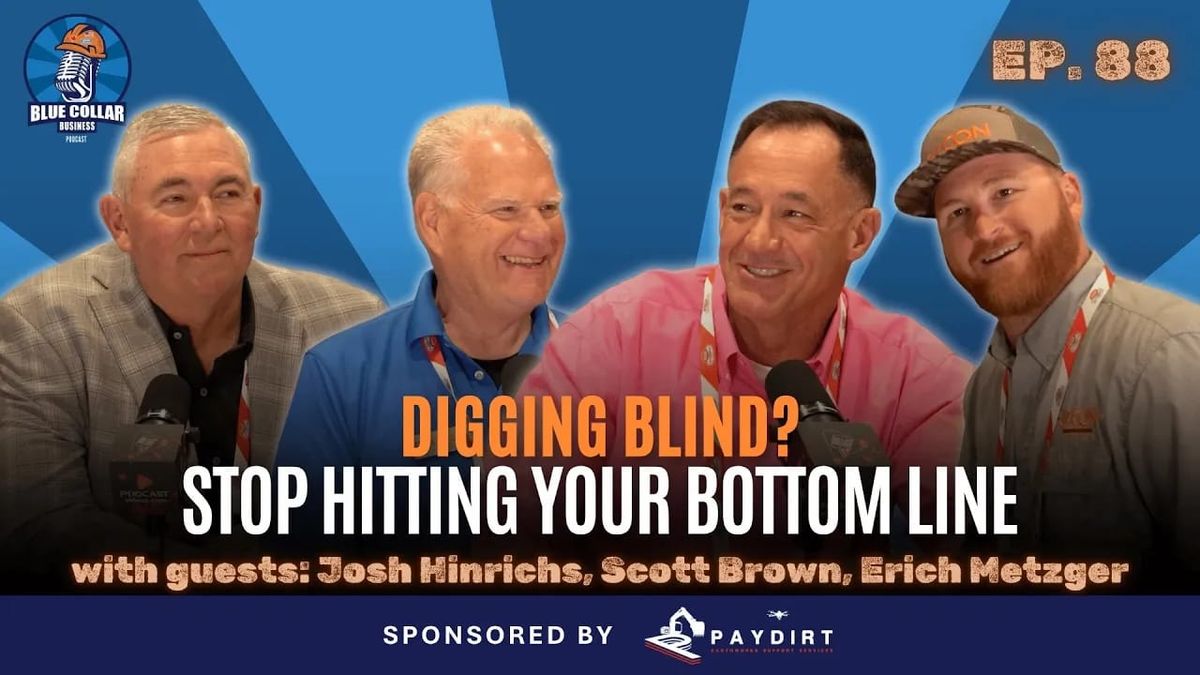
Unmarked utilities and accidental strikes are more than just a nuisance; they are massive profit leaks that put lives at risk every single day. In an industry where the pressure to produce often outweighs the patience to be safe, the "boots on the ground" are frequently the ones left holding the bag when things go sideways. In this episode, I sit down at the Common Ground Alliance (CGA) conference with industry veterans Josh Hinrich, Scott Brown, and Eric Metzger to bridge the gap between those who mark the lines and those who dig them.
We sit down to dismantle the adversarial relationship between excavators and locators to find a more profitable, safer path forward. We get into the tactical realities of damage prevention, including the implementation of "positive response" systems, the technical challenges of directional drilling, and why "white lining" your job site is a non-negotiable step for crew efficiency. The panel shares the "secret sauce" of utility safety: a culture shift toward "trust but verify" that moves beyond the paperwork and into real-time communication between stakeholders.
The unglamorous truth is that our industry is facing a massive knowledge gap and a turnover crisis in the locating community that affects your bottom line. Whether it's the overwhelming volume of tickets from fiber buildouts or the struggle to provide safety training across language barriers, the logistics of keeping a job site "clean" are getting harder, not easier. You will walk away with a clear understanding of how to use CGA best practices to protect your business and a mindset shift that views the local locator as a partner rather than a hurdle.
If you care about protecting your crew, minimizing downtime, and mastering the logistics of underground utilities, you’ll get a lot from this episode. Please subscribe and share this with anyone in the trades who is tired of playing "utility roulette" on their job sites.
More About this Episode
Bridging the Gap: Why Damage Prevention is Every Contractor’s Business
We often talk about the "boots on the ground" reality of the blue collar world. It is gritty, fast paced, and high pressure. But there is a silent layer beneath our feet that can turn a profitable day into a nightmare in a matter of seconds. I am talking about our underground infrastructure. For years, there has been a visible tension between those of us digging the dirt and the folks marking the lines. It has felt like an "us versus them" mentality, with contractors on one side just trying to hit production goals and utility locators on the other side buried under a mountain of tickets.
Recently, I had the opportunity to sit down with three absolute titans in the industry: Josh Hinrichs of Silver Tip Consulting, Scott Brown from Washington Gas, and Erich Metzger of SOCOM Underground. Between them, they have nearly a century of experience in damage prevention and utility locating. What I learned from them is that the gap between the excavator and the locator is closing, but it only happens when we prioritize culture over shortcuts.
The True Cost of Shortcuts
We have all heard the old saying that we do not have time to do it right, but we always have time to do it over. In the world of utility digging, "doing it over" might mean an insurance claim, a massive fine, or worse, a trip to the hospital. Josh Hinrichs made a point that really stuck with me: consistency is the only way to protect your bottom line. Damage prevention is not a box you check when you have a spare minute; it is a mindset that has to be applied every single time you arrive at a job site.
When a crew takes a shortcut, they think they are saving an hour. But if you hit a line, that crew is shut down. You might have to redeploy your assets, wait for repairs, and deal with the fallout of a damaged relationship with the utility provider. As business owners, we need to ensure our individual crews understand that there are no shortcuts when it comes to the safety of underground facilities. Doing it right the first time is the only way to stay profitable.
Best Practices as a Toolbox, Not a Rulebook
One of the biggest resources available to us as contractors is the Common Ground Alliance (CGA) Best Practices. Scott Brown and Erich Metzger, who serve as co-chairs for the Best Practices Committee, are literally writing the manual on how to keep our job sites safe. These are not just arbitrary rules handed down from a boardroom; they are strategies voted on by industry stakeholders to ensure common sense is applied to the field.
For the younger generation of contractors, these practices are vital. We do not always have the luxury of waiting ten years for a foreman to gain "old school" experience. We are in an era where we rely more on systems, procedures, and technology. The Best Practices manual gives you the blueprint for everything from how to communicate with a call center to how to handle a mismatch. It is the collective wisdom of the industry turned into a searchable, usable tool.
The Human Element: Communication and Respect
Perhaps the most eye opening part of my conversation with Josh Hinrichs, Scott Brown, and Erich Metzger was the discussion regarding the locators themselves. It is easy to get frustrated when a locator is late or when the marks seem a little off. But we have to look at the reality they are facing.
In many parts of the country, a single locator might be carrying 60 to 90 tickets a day. They are often one person crews, working in remote locations or high traffic urban areas, trying to keep up with an impossible volume of work. When we roll up with a full crew and start "busting their chops" because they are behind, we are contributing to the high turnover that plagues the industry.
Scott Brown mentioned that the best locators and the best excavators have one thing in common: they communicate. Taking thirty seconds to shake a locator’s hand, show them exactly where you are digging, and establish a human connection can change the entire dynamic of a project. It turns a transaction into a partnership.
Leveraging Technology for Verification
We are living in an age where technology can give us an incredible amount of confidence before we ever put a shovel in the ground. Josh Hinrichs brought up the concept of "positive response," which is becoming more common across various states. Instead of guessing whether a site has been marked, you get a digital confirmation.
At Washington Gas, Scott Brown and his team have taken it a step further. They provide excavators with the same maps, GPS data, and photos that the locators use. This transparency builds trust. When the utility company shares its evidence with the contractor up front, it says, "We want you to be successful."
On the contractor side, Erich Metzger advocates for the "trust but verify" method. His crews sweep the area every morning before they excavate. Investing in your own internal locating capability or simply taking the time to pot hole and verify marks is not a waste of time; it is an investment in your company’s survival.
Building a Safety Culture
At the end of the day, all the technology and best practices in the world won't save a company with a broken culture. I have been there myself. A few years ago, my company was growing fast, but our culture was suffering. I was so focused on production that I didn't realize my teams were overwhelmed.
I had to learn to implement "Take Five." Whether it is five seconds, five minutes, or five days of planning, we have to give our people the authority to stop work if something doesn't feel right. As Erich Metzger pointed out, leadership is about making sure your employees know the expectations and feel sincere support from the top. If you tell a guy he has stop work authority but then scream at him for slowing down production, you don't actually have a safety culture.
We also have to recognize the diversity of our workforce. Scott Brown highlighted the importance of providing training in Spanish. In many areas, a huge percentage of the workforce speaks Spanish as a first language. If your safety manuals and training modules are only in English, you are effectively leaving a third of your team in the dark. Bridging that language gap is a crucial part of modern damage prevention.
The Path Forward
The industry is changing faster than ever. With massive fiber build outs and aging infrastructure, the demands on locators and contractors are only going to increase. We cannot afford to view the other stakeholders in this process as adversaries.
We need to make utility locating a respected career path again, and we need to ensure that excavators have a seat at the table when rules are being made. By participating in organizations like the CGA and adopting these best practices, we are protecting more than just a pipe or a cable; we are protecting the people who build our communities.
Let’s commit to being the kind of contractors who white line our job sites, limit our ticket sizes to what we actually need, and treat every locator with the respect they deserve. When we work together, we all go home safe, and we all stay profitable.
What is one change you can make in your morning routine this week to improve communication with the locators in your area?
Member discussion: