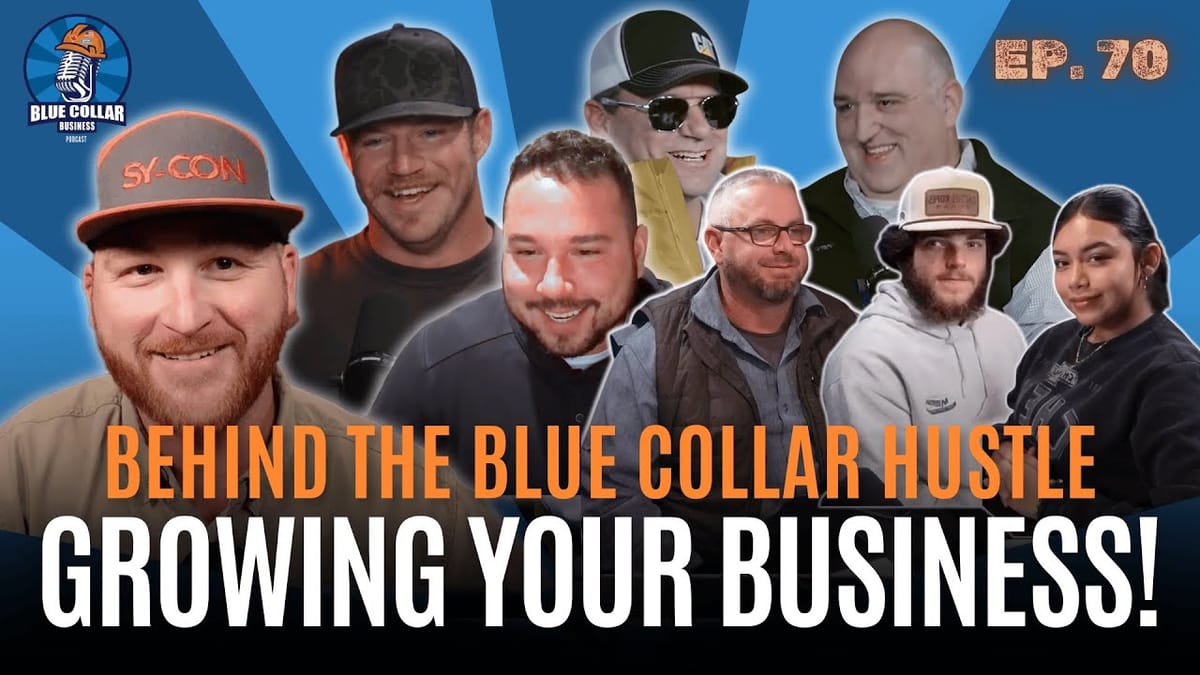
The jump from “busy” to “built” is where most blue collar shops stall. We open the hood on that leap, talking through the real costs of scaling past $1M: quality wobbling under volume, crews chasing equipment, cash flow stretched by 90-day waits, and owners buying back time with chaos. The fix isn’t a secret playbook, it’s simple systems, written approvals, and leadership that others can follow when you’re not on site.
Sy sits down with operators and educators who have lived the hits: getting burned on GC change orders, learning to say “email me that approval,” and rebuilding margins without burning bridges. We unpack why documentation matters more than bravado, how to point to the bid set without sounding defensive, and where confidence and clarity protect both relationships and profit. Along the way, we celebrate a public-school heavy equipment program that’s the model everyone asks for but rarely builds; students running dozers, installing silt fence, pulling real permits, fixing real mistakes, and walking into city offices with competence and connections.
We also dive into transparent coaching and the Dirt to Dollars philosophy: answer the ten context questions before you give advice, share the ugly alongside the wins, and teach owners to step off the machine and into pricing, scheduling, and cash discipline. If you’re stuck in the mud, mentally, financially, or operationally, mourn the hit, then choose a plan. Hard work is the baseline; the leverage is systems, written change orders, and relationships that compound. Whether you’re an employee hungry to level up or an owner tempted to grab the controls again, you’ll leave with practical steps to protect your margins, grow your team, and build a legacy in people, not just projects.
Like what you heard? Subscribe, share with a fellow operator, and drop a review so more builders can find the show. Got a guest or question we should tackle next? Tell us and we’ll dig in.
Follow and stay connected:
Never miss an update—follow, subscribe, and join the conversation!
More About this Episode
Breaking Through the Growth Ceiling: Real Talk on Scaling Blue Collar Businesses
Running a blue collar business isn’t for the faint of heart. It’s gritty, high-stakes, and full of trial-by-fire moments that rarely get shared outside the job site. But if there’s one thing we need more of in this space, it’s honest conversations about what it really takes to scale.
In this episode of the Blue Collar Business Podcast, we took a deep dive into the often overlooked challenges of growing beyond the $1 million revenue mark, and what it really means to lead, scale, and survive in the trenches of this industry. This isn’t a highlight reel. It’s raw, real, and full of the hard-earned lessons that don’t get taught in any manual.
Let’s get into the core takeaways for any business owner staring down the next big leap.
The $750K to $2M Revenue Plateau: Why Growth Gets Harder
If you’re in the early growth phase, going from $100K to $500K, maybe even $750K in revenue, growth can feel like it’s on autopilot. A few good jobs, a small team, and some good old-fashioned hustle, that’s enough to move the needle.
But as our guests pointed out, everything changes past the $1M mark. That’s when the wheels start to shake unless you’re building systems.
You’ll need:
- More admin support
- Project managers
- Operations processes
- Scheduling systems
- And most importantly: documented knowledge transfer
The problem? Most of us don’t even know we need these things until we’re overwhelmed and on the verge of burnout. We’re stuck "throwing darts at the wall," hoping that one of them buys us some time. But without systems, you’re not building a business, you’re just working a job with more stress.
"You're finally locking in some good work, people know who you are, things are rocking and rolling… and then you're staring down a $2M beast that you're not ready to feed."
This is the turning point. If you want to go from a six-figure operator to a seven-figure business owner, you’ve got to change how you work.
Growth Without Systems Will Wreck Your Team
We’ve all heard the saying: “What got you here won’t get you there.” Nowhere is that more true than in blue collar business.
Without systems, your people don’t know where the company’s headed. They can’t see the vision, not because they don’t care, but because you haven’t shown them. That lack of clarity leads to good people walking away. The real tragedy? They could’ve succeeded with you if they had a roadmap.
I share my own story of rapid scaling: doubling revenue year after year, watching operations spin out, and eventually realizing that quantity was killing quality. That’s the trap. More jobs, more equipment, more people. all leading to less control, more mistakes, and a loss of profitability.
When you’re constantly reacting, you don’t have time to fix the root issues. You’re busy chasing rakes for Miss Sally’s job instead of locking down your scheduling system or training your crew. Profitability slips through your fingers. You lose sleep. Your spouse starts asking where the money went. And you don’t have a good answer.
The fix? Documentation. Delegation. Communication. Build the damn systems before you need them.
Commercial Work Will Test Your Backbone
For many operators, the first big break into commercial work feels like the big leagues. More zeros, bigger projects, and the dream of steady contracts. But the reality? It’s a shark tank, especially if you're not ready to stand your ground.
You have to learn how to say no, protect your scope, and enforce change orders in writing. Not with a handshake. Not over the phone. In writing.
“They’ll muddy the waters just enough to drag you along and not pay you that $5K change order. And they’ll do it with a smile.”
We also outlined how some general contractors (GCs) operate: promising payment, requesting minor "favors," and slowly bleeding your job site dry. They delay approvals, avoid accountability, and put you in situations where you feel forced to eat the cost just to keep the job moving.
So what do you do?
- Get everything in writing. Texts, emails, documented bids. If you’re making changes, get it signed off.
- Don’t be afraid to be transparent about your margins. Trying to hide the fact you’re making money builds distrust.
- Know your worth and enforce boundaries. The ones who respect you will keep calling. The rest will get exposed over time.
From Operator to Owner: Making the Mental Switch
One of the most powerful takeaways from the conversation was around the mental leap required to go from operator to owner.
Whether you started mowing lawns, pressure washing, or grading driveways, at some point, you realize that your ability to scale has nothing to do with your machine skills. It’s about leadership, decision-making, and getting out of your own way.
That means:
- Letting go of the pilot’s chair (literally and metaphorically)
- Hiring for roles you once held
- Investing in the team instead of being the hero
- Learning business skills like finance, sales, and communication
As one guest said:
“I loved driving the truck. But if I’m still driving the lowboy, we’ve got bigger problems.”
Every blue collar business hits a point where the owner has to step back and start working on the business instead of just working in the business. That shift is uncomfortable. But it’s the only way to create long-term success, not just for you, but for your team and your family.
What It Really Means to Keep Going
For anyone stuck in the mud, mentally, financially, emotionally, the most powerful advice came near the end of the episode.
There’s no silver bullet. No perfect system. But there is a path forward.
You mourn the loss. You accept the hit. Then you keep going.
You keep going when:
- You lose $40K on a job
- You cry with your spouse in the driveway
- You don't know how payroll's getting met
- You question whether it’s even worth it
You feel it, but you don’t let it define you. That’s the difference. You get back in the saddle. You grab a mentor. You ask for help. You learn what you don’t know and then you teach the next person coming behind you.
The best advice wasn’t a tactic. It was a mindset.
“If you’re going to fail, go down swinging. And if I do go under, I’ll be back in business the next day.”
That’s what it means to be in this world. You’re not just building a company, you’re building a legacy in people. Employees. Family. Community. That’s the real ROI.
Final Word: Don’t Stay Stuck
The theme of this episode couldn’t be clearer: You’re not alone, but you have to move.
- Build systems before you scale
- Communicate clearly and protect your scope
- Learn the business side, not just the trade
- Stop hiding your struggles, get a mentor and ask for help
- Keep going, even when it feels like it’s falling apart
Whether you’re a seasoned operator or just starting your first solo gig, remember this:
The difference between stuck and scaling is in the systems and support you build.
The resources are out there. The knowledge is out there.
Get in the room. Get on the path. And whatever you do, don’t stop swinging.
Member discussion: