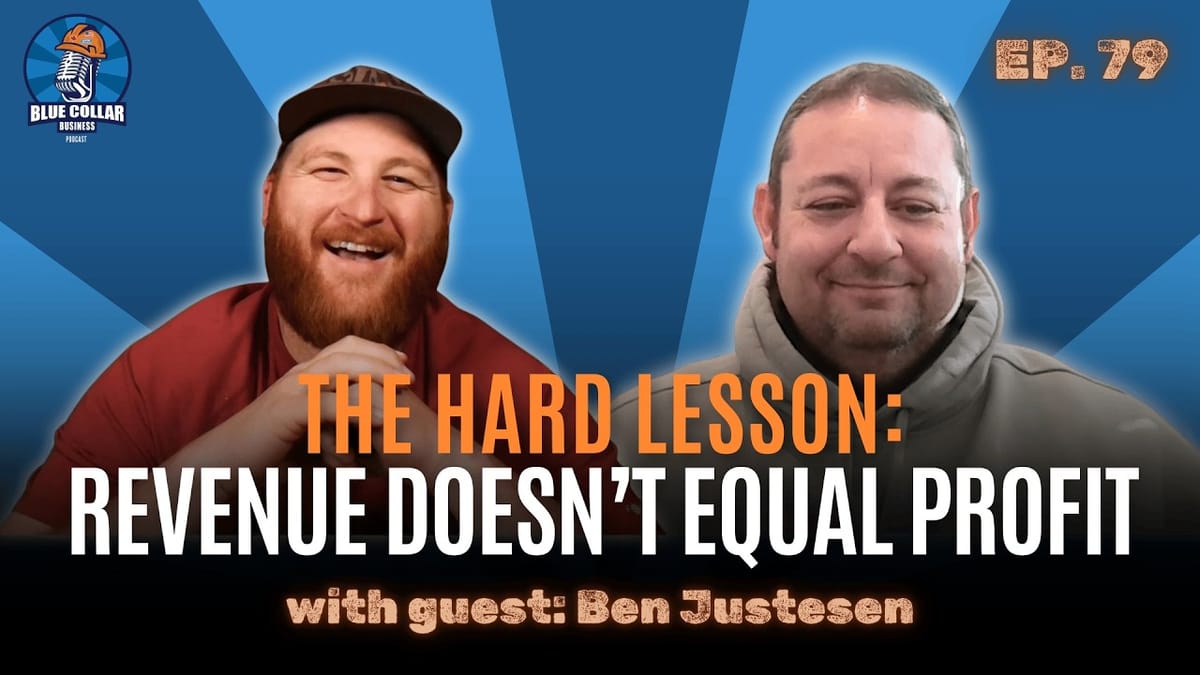
Ready to stop letting software and insurers set your prices? We sit down with restoration veteran and industry advocate Ben Justesen to map out a practical blueprint for blue-collar profit: building your own labor rates, managing WIP with confidence, and turning real culture into a recruiting edge. Ben’s story moves from a $400k patent lawsuit and five years of survival mode to leading markets in pricing by feeding data back into estimating platforms and, more importantly, engineering his own defensible rates from labor burden, overhead, and targeted margins.
We break down how to translate takeoffs into true budgets, why material margins are thin and labor must carry the difference, and how production rates, sourced from your historical job data, make estimates faster and more accurate. Cash flow gets a no-fluff treatment: progress billing tied to visible milestones, staying over-billed instead of being the bank, and aligning estimating, production, and accounting around a single WIP report so red flags show up while there’s still time to act.
Culture is the force multiplier. Ben details the shift from lip service to lived values like humility, initiative, ownership, and hunger, then shows how to hire for them with a recruiter’s route, structured interviews, and paid working days across departments. We also explore documentation tech, 360 job captures that let estimators scope remotely, lock down supplements, and eliminate disputes by showing before, during, and after in exact detail. That same documentation powers people-first marketing: celebrating crews and subs, earning name-specific reviews, and attracting talent who want to be part of a winning team.
If you’re a contractor who’s tired of thin margins, late cash, and chaotic hiring, this conversation hands you a clear playbook: build rates from your numbers, bill from visual milestones, track production relentlessly, and let your values drive every process. Enjoyed the episode? Subscribe, share it with a fellow builder, and leave a review with your biggest pricing or WIP breakthrough.
Tune in to the Blue Collar Business Podcast with Sy Kirby for the rawest, most relevant stories behind building a successful business in the trades. New episodes drop every Wednesday at 5 am CST—put your boots on and get ready to level up.
Follow and stay connected:
Never miss an update—follow, subscribe, and join the conversation!
More About this Episode
The Survival Strategy of Overbilling: Mastering Construction Cashflow
In the world of blue collar business, there is a tax most of us pay early on. I call it the "ignorance tax." It is that painful period where you are working your tail off, landing jobs, and seeing revenue climb, yet somehow your bank account is bone dry. You’re robbing Peter to pay Paul, staring at a screen trying to figure out how a three million dollar year felt less profitable than a one million dollar year.
I recently sat down with Ben Justesen, a 20 year veteran of the restoration and construction industry, to talk about the hard lessons learned in the trenches of Moses Lake, Washington. Ben’s journey is a mirror for many of us: taking over a family business, facing a devastating 400,000 dollar lawsuit that he didn't see coming, and surviving five years in "survival mode" before finally cracking the code on cashflow and culture.
The reality of the trades is that we are capital intensive. We buy the trucks, we buy the fuel, we pay the labor, and we front the materials. If you aren't careful, you become the bank for your customers. And let me tell you, being a bank is a quick way to go broke.
The Trap of Underbilling
Most contractors, especially when they are hungry and starting out, fall into the trap of underbilling. You are so worried about keeping the client happy or "getting the job" that you wait until milestones are fully completed before asking for a dime.
Ben and I discussed the "Work in Progress" (WIP) report, which is a document every business owner needs to live by. If you have ten projects going and you are underbilled on all of them, your life is going to be hell. You are incurring costs every single day before you even step foot on the job site. There are submittals, mobilization, erosion control, and material orders.
The goal is to stay overbilled. This doesn't mean you are cheating the customer; it means you are getting paid for the work as it happens, or slightly ahead of the cost curve, so you aren't using your own survival capital to fund their project.
Setting Visual Expectations
One of the biggest hurdles for contractors is the "money conversation." We have a lot of empathy; we don't want to feel like we are "squeezing" people. But there is a massive difference between being nice and being kind. Being nice is avoiding the hard talk and going out of business. Being kind is setting clear expectations so there are no surprises.
Ben’s strategy for this is brilliant: Visual Milestones.
Instead of telling a customer you’ll bill them when you hit 50,000 dollars, tell them the payment schedule follows the physical progress of the house.
- Payment 1: Mobilization and Demolition.
- Payment 2: Insulation and Drywall.
- Payment 3: Prior to the first coat of primer.
When a customer can see the progress, they feel comfortable releasing the funds. You have to talk about this process at least two or three times before you even arrive on site. If you set the expectation early, it’s just a process. If you bring it up for the first time when you need the check, it feels like a confrontation.
Knowing Your True Costs: Beyond the Software
In the restoration world, and increasingly in excavation and general contracting, we rely heavily on estimating software. The danger is that many guys don't actually know what is inside those line items. They trust the "market rate" the software spits out without checking if that rate actually covers their unique overhead.
Your overhead is not a static number. It changes as your revenue changes. Ben actually developed a labor rate calculator because he realized most guys couldn't calculate their labor burden.
What is Labor Burden? It’s not just the hourly wage you pay your guys. It’s the FICA, the payroll taxes, the Medicare, the workers' comp, and the benefits.
If you don't know your production rates, how many man-hours it actually takes your crew to install 500 feet of pipe or dry out a 2,000 square foot basement, you are just guessing. And in this economy, with tighter margins and rising material costs, guessing is a death sentence.
The Three Pillars of a Profitable Project
To move out of survival mode and into a thriving business, you need three wheels turning in sync:
- Estimation: Accurately predicting the cost of every stick of wood and every man-hour.
- Production: Tracking the actual work in the field against the estimate in real-time.
- Accounting: Ensuring the billing matches the production so the cashflow stays positive.
If your field lead calls you two weeks into a job and says, "We bid 2,000 tons of gravel but we’re already at 2,800 tons and we're only halfway," that is a win. Why? Because you caught it while you still have time to find the error or file a change order, rather than finding out at the end of the month when the bank account is empty.
Culture as a Recruitment Tool
We talk a lot about culture, but Ben brought up a point that really hit home: Repeatable unacceptable behavior is the death of culture. You can have "Integrity" written on the wall, but if you allow a toxic high-performer to stay on the team, that is your real culture. Ben moved his company to a "One-Day Paid Working Interview." He would pay a candidate to work a full day with every department. At the end of the day, the team would debrief based on four core values:
- No job is beneath us.
- Doing without having to be asked.
- Determined to succeed.
- Taking ownership.
When your team owns the hiring process, they protect the culture. They don't want to work with someone who doesn't pull their weight. This shift changed his business from one that "lip-serviced" culture to one that attracted talent from across the country.
Winning at Home
At the end of the day, Ben’s biggest piece of advice wasn't about a spreadsheet or a software. It was about taking care of yourself. We get so caught up in the grind, the 2 a.m. emergency calls, and the stress of the payroll cycle that we forget why we started. If you aren't winning at home, you aren't winning. You need to have 100% input, physically, mentally, and emotionally, before you can give 100% output to your business.
Don't be afraid of your competition. Have an abundance mindset. Share what you know, tighten up your billing, and remember that the people on your trucks are the most valuable asset you own.
Member discussion: