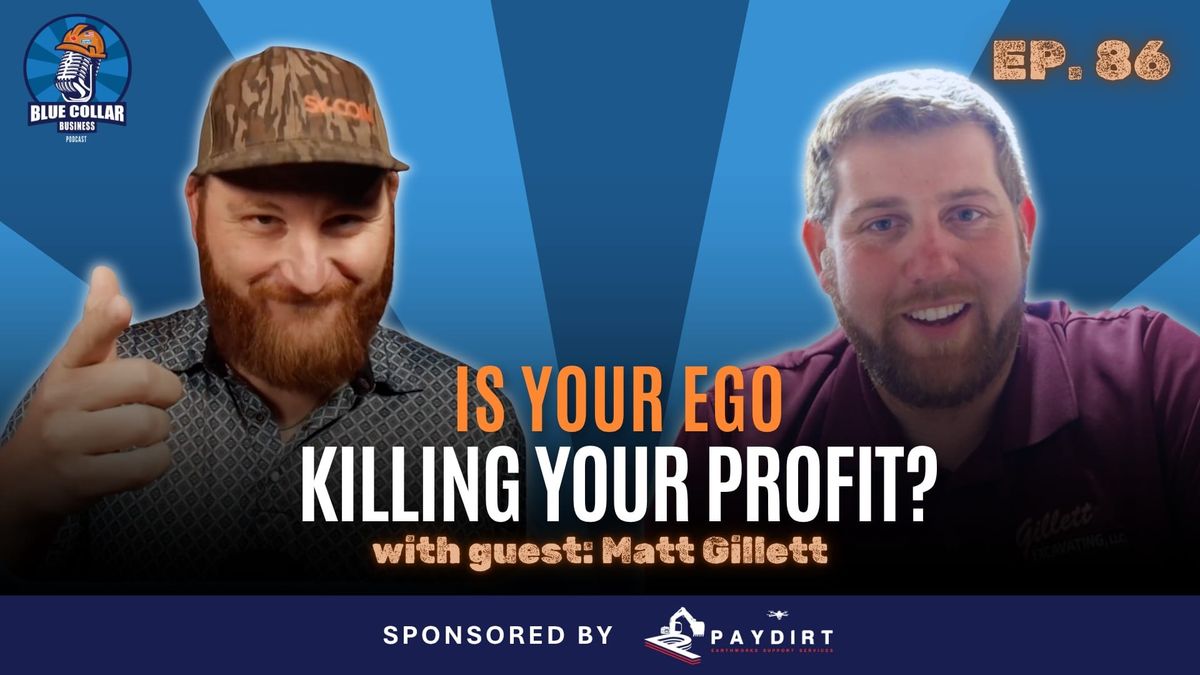
Downtime is not a mechanic problem, it is a profit leak that can wipe out a week of work in two days. We sit down with Matt Gillett, founder of Gillett Excavating in Michigan, to tell the truth about what it takes to grow an excavation company from a $500 start into a full service heavy civil construction and underground utilities contractor. The stories are raw because the lessons are expensive, and we want you to steal the learning without paying the same tuition.
We get into the real-world tech debate around GPS machine control and total station guided grading: when it boosts production, when it creates another failure point, and why operator skill still has to come first. Matt breaks down his switch back to Trimble after trying Topcon, plus how he thinks about automated dozers, 3D excavators, and “indicate only” setups for tighter sites and faster decision making. If you are bidding commercial work, expanding into mass grading, or trying to decide whether to invest in GPS guided equipment, this will help you ask better questions.
Then we go where most podcasts avoid: equipment payments, cash flow, and the brutal moments that force clarity. Matt shares what late pay can do to a growing contractor, the hard cuts he made when life changed, and why the real mission is family, not a never-ending business fire drill. We close with leadership that scales: core values you can hire and fire by, and the “first 30 last 30” system that sets expectations, improves safety, and keeps crews productive.
Subscribe for more blue collar business advice, share this with a contractor who is feeling the pressure, and leave a review so more excavation and heavy civil owners can find these conversations.
More About this Episode
Scaling the Heights of Heavy Civil: Why Systems and Integrity Trump Iron and Ego
Every entrepreneur in the dirt world has a "truck and a trailer" story. For me, it was a rotted out pickup and about five hundred dollars to my name. For Matt Gillette of Gillette Excavating, it was a similar scene in the uplands of Michigan, starting at just nineteen years old with a drive to prove he could do it better than the generation before him. We recently sat down to talk shop, and while our geographies are a world apart (my Arkansas red clay versus his Michigan frost lines), the lessons we have learned through trial, error, and a massive amount of capital are identical.
Building a heavy civil firm from the ground up is not just about moving dirt; it is about managing the crushing weight of overhead, the complexity of human nature, and the realization that your ego is often your own worst enemy. Whether you are cutting your teeth in residential fine grading or laying miles of deep utility pipe, the transition from a "guy in a seat" to a business owner requires a fundamental shift in how you view your equipment, your people, and your time.
The High Cost of the "Roll the Dice" Mentality
In this industry, we are often seduced by the idea of cheap iron. When you are starting out, a used excavator with six thousand hours looks like a bargain compared to the staggering monthly payment of a brand new unit. However, both Matt and I have learned the hard way that the payment on a machine is rarely your biggest expense. The real killer is downtime.
If a mainline pipe crew is capable of generating ten to fifteen thousand dollars in revenue a day, a broken machine is not just a five thousand dollar repair bill; it is a twenty thousand dollar catastrophe. You are paying for the parts and the labor, but you are also paying for a crew to stand around, the logistics of moving dead iron across state lines, and the cost of an emergency rental. When you do the math, paying an extra fourteen hundred dollars a month for a new machine under warranty starts to look like a very cheap insurance policy.
The "dinosaur" machines of our fathers' era, the ones you could fix with a wrench and some sweat, are gone. Today’s machines are packed with technology that requires a dealer plug in just to diagnose. Embracing newer iron with PM agreements and warranties is not about being flashy; it is about protecting your cash flow from the volatility of catastrophic mechanical failure.
Machine Control: A Tool for Skilled Hands, Not a Replacement
There is a massive debate in the grading and utility world regarding GPS and machine control. Matt found his stride early on by utilizing Total Station guided grading (UTS) for high tolerance parking lot work. It allowed his team to jump from grading sixty thousand square feet a day to over one hundred thousand square feet while maintaining a tolerance of plus or minus a quarter inch.
But here is the catch: technology should make a good operator better, not a bad operator passable. There is a dangerous trend of trying to "import" eighteen year olds directly into the seats of eighty thousand pound excavators with the hope that the technology will do the thinking for them. This is a recipe for disaster.
An operator who has never spent years in the trench with a shovel or swamped for a mainline digger lacks the "dirt sense" required to verify if the GPS is lying to them. You need to understand the material, feel the machine, and know how to spot for a brother in the hole. Technology is a weapon, but only if the person wielding it understands the fundamentals of the trade. If you want to be the supreme contractor in your area, you must have the courage to tell a new hire that they are starting with a shovel. You have to earn the seat by understanding the ground first.
The Hard Reset: When the Business Owns You
Scaling a business is rarely a straight line. Often, we find ourselves in what I call the "hamster wheel of death." You add more crews, more equipment, and more revenue, but your profit margins stay flat or even shrink. You are supporting a team and a fleet, but the business is no longer serving you.
Matt shared a powerful story about the day his child was born. While most fathers are focused solely on the hospital room, Matt had to step into the hallway to fire ten people and sell seven pieces of equipment. He was being drowned by "boat anchors," specifically heavy payments and dead weight employees that were consuming his life.
It takes a massive amount of humility to realize that "big" is not always "better." Many of us get caught up in the ego of having seven crews and a massive yard full of iron, but if that operation is not profitable and is stealing your time from your family, it is a failed mission. The business is a side mission; the family is the main mission. Sometimes you have to perform a "cleansing" to get back to the core of why you started in the first place.
Systems, Processes, and the "First 30, Last 30"
The difference between a tradesman and a business owner is systems. Without them, you are relying entirely on the individual skills of your people, which is not a repeatable or scalable model.
One of the most effective systems Matt implemented is the "First 30 and Last 30" rule.
The First 30: The first thirty minutes of the day are for the foreman to present a written plan, hold a site safety meeting, and assign specific production goals to every man on the crew. The windows get cleaned, the fluids get checked, and everyone knows exactly what success looks like for that day.
The Last 30: The final thirty minutes are for cleaning the site, fueling and greasing the equipment, and parking the fleet in an organized manner. Crucially, the foreman must submit a written plan for the following day so the team is prepared before they even step foot on site the next morning.
When these systems break, the day turns to chaos. You get reworks, missed maintenance, and lost production. Systems take the emotion out of management. If a mistake is made, it is not a personal attack; it is a failure of the process.
Leading with Core Values and Integrity
Finally, you cannot build a sustainable company on ego. This industry is filled with "egotistical maniacs," but the most successful long term players are those who lead with humility.
Establishing core values, like integrity, accountability, and family first, is not just corporate fluff. These are the tools you use to coach your team. When an employee makes a bad decision, you don't have to scream or belittle them. You simply ask, "Is that decision in line with the core values we all agreed upon?" It is a much more powerful way to course correct because it appeals to their character rather than their fear.
We are all in this together. Whether you are sinking an excavator in a Michigan swamp or struggling with cash flow in the Arkansas heat, remember that you are not alone. Reach out to other owners, find mentors who have been through the fire, and never stop working on yourself. The reward on the other side of these brutally hard years is a business that runs efficiently, supports the families of your employees, and allows you the freedom to be present for your own family.
Stay safe in the trenches, keep your ego in check, and let’s keep building.
Member discussion: