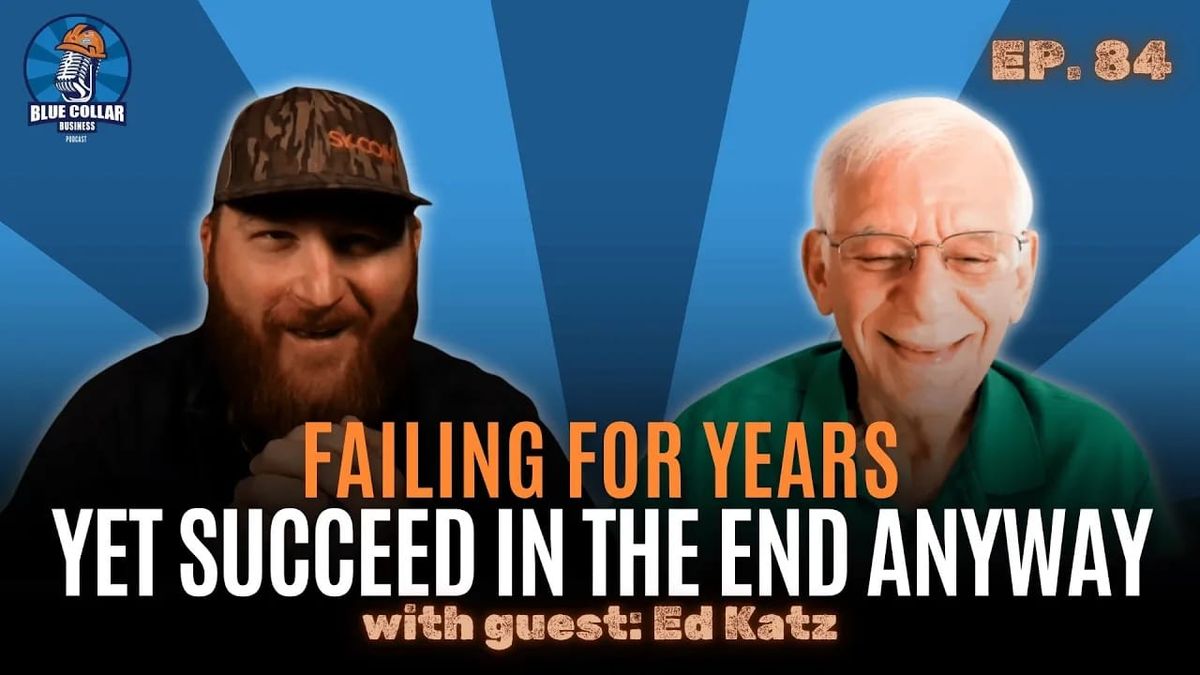
A competitor ten times bigger rolls into town, undercuts your price, and takes your market share nearly overnight. Most owners panic, cut margins, and burn out. Ed Katz did something different: he listened to what customers kept asking for, built a system to deliver it, and turned adversity into a breakthrough that transformed commercial moving.
We talk through Ed’s path from Wall Street to entrepreneurship, why “identifying a need” puts you most of the way to the goal line, and how one ugly Friday-night breakdown taught him the real value of processes and contingency planning. Then we get practical about estimating: why accurate man-hours and a repeatable formula beat gut feel every time, whether you run office relocations, excavation, concrete, electrical, or any other service business where one bad bid can wipe out months of profit.
The story takes a wild turn with Ed’s “boxless move” innovation: space gobblers that let teams move desks without emptying drawers and the spider crane that safely lifts loaded file cabinets. That differentiation didn’t just win jobs, it let him charge premium pricing while delivering a better customer experience. We also get into leadership lessons every blue collar business owner needs, including the moment Ed realized he had built an upside-down org chart and the seven words that started creating real decision-makers on his team.
If you want better estimating, stronger systems and processes, and a clearer way to stand out in a crowded market, press play. Subscribe to the Blue Collar Business Podcast, share this with a friend in the trades, and leave a review so more owners can find it.
Tune in to the Blue Collar Business Podcast with Sy Kirby for the rawest, most relevant stories behind building a successful business in the trades. New episodes drop every Wednesday at 5 am CST—put your boots on and get ready to level up.
Follow and stay connected:
Never miss an update—follow, subscribe, and join the conversation!
More About this Episode
From Lumper to Legend: The Systems and Innovation That Define a Blue Collar Legacy
Success in the blue collar world is rarely a straight line. Most of us start in the trenches, literally and figuratively, grinding through the physical labor while trying to figure out how to keep the lights on and the trucks running. My journey began as a lumper, doing the backbreaking work that defines the moving industry. I had a master’s degree from Wall Street experience, but none of that mattered when I was hauling furniture in the Georgia heat. What did matter, and what eventually separated my business from every other mover in Atlanta, was a relentless obsession with identifying needs, building repeatable systems, and daring to innovate when the rest of the industry was stuck in its old ways.
If you feel like you are chasing your tail or drowning in the day to day chaos of your business, you are not alone. I have made every mistake in the book. The key is that I made each one exactly once. By turning those failures into processes, I built a company that didn't just survive but dominated its market.
Identify the Need and Specialize
One of the biggest traps in the service industry is trying to be everything to everyone. When I started Peachtree Movers in 1976, the competition was a sea of generalists. They moved households, and when things got slow, they filled the gaps with office moves. Because they weren't specialists, their service was inconsistent. Jobs didn't finish on time, pricing was a guessing game, and they frequently caused enough damage to put a company out of business for days.
I saw the gap. I realized that the commercial sector needed a mover that understood the high stakes of a business relocation. If a business isn't open on Monday morning, they are losing money. By specializing in local office moving, I could focus my energy on solving the specific problems of that niche. In any trade whether you are an electrician, a plumber, or a pipe layer there are riches in the niches. Find the one thing people are complaining about and become the undisputed expert at solving it.
Stop Following the Followers: The Man Hour Formula
For decades, the moving industry used a residential formula based on cubic feet and pounds to estimate office moves. It was a disaster. There is no relationship between the weight of a desk and the time it takes to navigate a 50 story office building with a slow freight elevator. I learned this the hard way on a Sunday evening, three hours behind schedule, with a crew ready to mutiny and an angry client breathing down my neck.
I realized I had to stop following the followers. I looked outside my industry to the construction world. If a contractor can estimate exactly how many hours it takes to excavate a foundation or anchor a skyscraper, why couldn't I do the same for moving? I developed a proprietary formula based entirely on man hours.
By breaking the job down into quantifiable units of time rather than weight, our estimates became 97.6% accurate. We weren't just guessing anymore; we were engineering a move. This system allowed me to hire professional salespeople who didn't need years of manual labor experience to quote a job. They just needed to follow the system. If you don't have a formula for your costs and your time, you aren't running a business; you are gambling.
Innovation Born of Adversity: The Boxless Move
Even with great systems, you will eventually face a "Job moment”. A period of testing that feels like it might break you. For me, that was the arrival of a massive competitor from Chicago. They had more trucks, deeper pockets, and they were 10% cheaper. Overnight, I lost my market share.
I was desperate, but that desperation forced me to do something I hadn't truly done before: I listened to the customer. For years, clients asked if they had to empty their desks and file cabinets. Every mover said yes. I decided to find a way to say no. Through a lot of prayer and trial and error, I developed the "boxless move" method.
I invented the Spider Crane and Space Gobblers. Patented equipment designed to move fully loaded lateral file cabinets and desks without damaging them or their contents. We became the only mover in the world that could move a business without making them pack. Because we offered a service no one else could, we didn't just win back our market share; we doubled our prices. We stopped competing on price and started competing on value. Adversity isn't the end of your story; it's often the catalyst for the innovation that will define your career.
The Seven Most Important Words in Management
As the business grew, I fell into another common trap: I became the bottleneck. I was the "Grand Moveti," and every single decision, from a client letter to a tire change, had to go through me. I had created a team of mentally handicapped employees because I never gave them the space to think.
The turning point happened in a bathroom stall when an employee interrupted my private moment to ask a basic question. I realized then that I had no life because I had no leadership structure. I adopted a new philosophy centered on seven words: "I don't know. What do you think?"
When you empower your team to bring you solutions instead of just problems, the business starts to breathe. I required my staff to bring me three options for any issue they encountered. Most of the time, their preferred option was the right one. This shifted the culture from one of dependency to one of ownership. If you are "babysitting" grown men, you aren't managing. True management is being responsible for the performance and behavior of your people by giving them the tools and the authority to succeed.
The Mission Statement as a Daily Tool
Many companies treat their mission statement as a dusty plaque on the wall. At Peachtree Movers, "Become the most user friendly office mover in Atlanta" was our daily management tool. I would ask employees at every level, from the bookkeepers to the lumper helpers, what the mission statement was and how they were living it.
This simple focus sparked incredible ideas. A lumper named Dexter figured out how to use our Space Gobblers to move fragile blueprint files full, a task we previously thought impossible. A bookkeeper realized she could prioritize the billing for our most loyal clients to make their lives easier. When your team understands the "why" behind the business, they will find better ways to execute the "how."
Final Thoughts: Persistence and Perspective
If you are in the middle of a struggle right now, I have one piece of advice: Don't give up. The three Ps: patience, persistence, and perseverance. Those are the only things that will carry you through the cycles of business. Every day that the earth is below you instead of above you is a gift and an opportunity to improve.
Check your own leadership first. Most of the bottlenecks in your company are staring back at you in the mirror. Build your systems, empower your people, and never stop looking for a better way to serve your customer. Whether you are moving office furniture or laying pipe, the principles of excellence are the same. Stay focused, stay humble, and keep expanding your toolbox.

Member discussion: