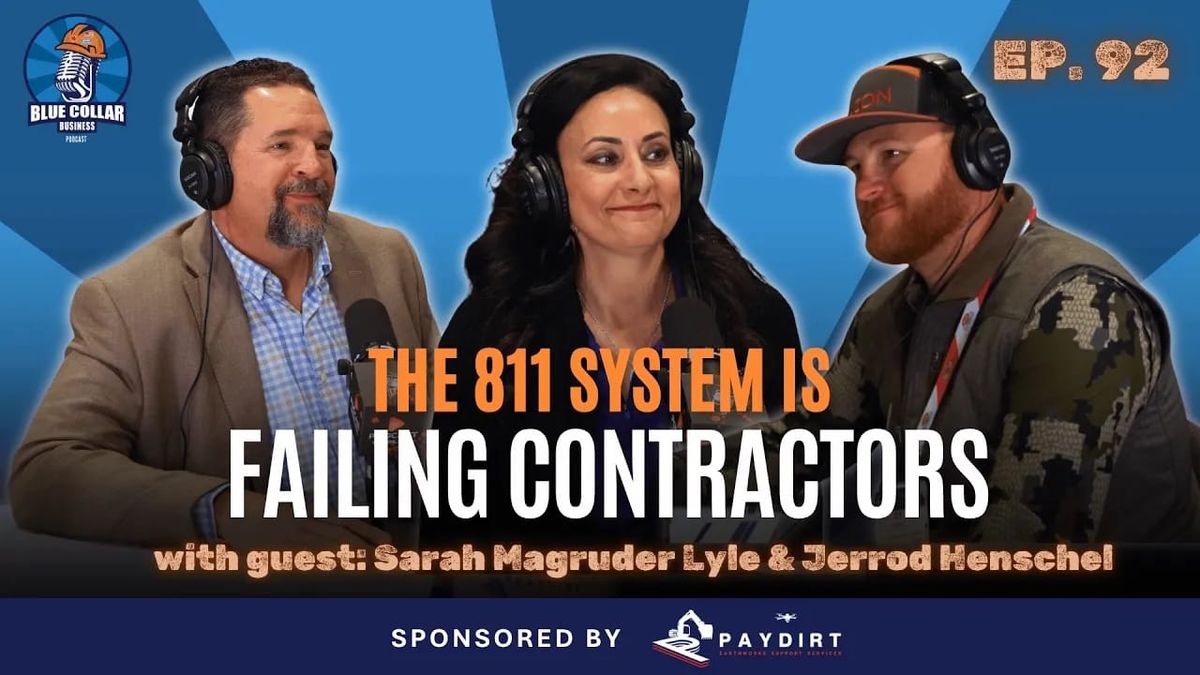
The hidden cost of bad excavation data isn't just a hit to your bottom line; it is a direct threat to the lives of your crew members on site. When project owners withhold accurate utility maps to shield themselves from legal fault, field crews are left to dig blind, relying on paint lines that might not tell the whole story. We sit down with Sarah Magruder Lyle and Jerrod Henschel at the CGA Conference to look closely at why relying on basic compliance is no longer enough to protect underground workers.
We get into the specific operational bottlenecks that occur when field teams over-notify tickets, which accidentally forces utility locators to rush through critical safety checks. The conversation covers the legislative push for mandatory reporting, the ongoing efforts to remove municipal exemptions, and how the DIRT report is being used to accurately track fault. Jerrod Henschel shares his perspective on the financial realities of field downtime, highlighting why structured advocacy is the only way to challenge outdated state codes.
Fixing a fragmented system requires moving past finger-pointing and realizing that safety rules are dictated state by state. Every territory operates under a separate regulatory framework, meaning a process that keeps a crew safe in one county could lead to a severe strike just across the state line. True progress requires shifting from reactive problem-solving to proactive legislative engagement before bad policy is signed into law.
More About this Episode
Changing the Rules of the Game: Why Damage Prevention Needs Active Advocacy
Every single day, underground contractors, utility locators, and project owners step onto job sites facing a heavy reality. When you are burying 95% of your work to never be seen again, the stakes are incredibly high. One wrong move, one inaccurate locate, or one outdated map can lead to a strike that shuts down a community, costs thousands of dollars in downtime, or worse, threatens someone's life.
For a long time, there has been a lingering frustration in the excavation community. Contractors often feel like they get blamed for every incident and end up paying for the fallout. It is true that the excavator is almost always the one who causes the physical damage, but that does not mean it is automatically the excavator's fault.
To bridge this gap and truly protect the people in the field, the industry has to shift away from pointing fingers and move toward systemic, structural change. Achieving this requires looking closely at how damage prevention is handled on both a practical level and a legislative level.
The Dynamic Between CGA and DPAC
Many professionals in the blue-collar space are familiar with the Common Ground Alliance (CGA). As a non-profit organization, the CGA has done incredible work establishing best practices, fostering communication among different stakeholder groups, and pulling together resources to reduce utility strikes. However, because the CGA is structured as a 501(c)(3) organization, it faces strict legal limits when it comes to lobbying and pushing for specific legislative changes.
To achieve a major goal, such as reducing utility damages by 50% within a five-year window, the industry cannot just rely on voluntary guidelines. The rules of the game have to change. This realization led to the creation of the Damage Prevention Action Center (DPAC), a completely separate 501(c)(4) organization.
While the CGA focuses on industry collaboration and data collection, DPAC is built entirely around issue advocacy and lobbying. There has never been an association solely focused on damage prevention from the legislative side. DPAC fills that void by taking the conversation directly to governors, state legislators, and state attorneys general to advocate for balanced, effective enforcement.
Over-Notification and the Real Cost of Free Tickets
One of the most immediate practical challenges facing damage prevention is the sheer volume and size of locate tickets moving through the 811 system. It is a common misconception that because calling in a locate ticket is a free service, it does not cost anything. In reality, free costs someone else a substantial amount of money, and it eventually loops back to hurt the contractor.
When contractors practice over-notification, calling in 30 different sites or a mile-long run when they only plan to work on a 2,000-foot section that week, it puts a massive strain on the system. No other industry allows someone to submit a thousand requests and demand that they all be completed within the exact same 48-hour or 72-hour window. This practice stretches an already strained workforce of utility locators incredibly thin.
When locators are forced to rush to meet impossible deadlines, inaccuracies happen. A crew ends up standing around waiting for paint, or worse, digging on a site that was marked poorly. To prevent this, contractors must reduce ticket sizes and match their locate requests to their actual production schedules. Better ticket management keeps the system accurate and keeps crews moving safely.
The Landscape of State-Level Legislation
A major point of confusion for many regional contractors is the assumption that 811 operates under a single, uniform federal law. The federal law establishes the baseline floor, requiring every state to maintain at least one 811 call center. Beyond that baseline, states are like snowflakes: no two states in the country have the exact same damage prevention laws.
The only federally regulated utilities are pipelines, governed under the Pipeline and Hazardous Materials Safety Administration (PHMSA) and the federal Pipes Act. Because pipelines carry materials with significant ignition risks, their operators face high safety standards, mandatory reporting, and strict penalties. However, the federal government does not have the authority to regulate fiber, water, sewer, or local power lines in the same way. Those utilities are regulated entirely at the state level.
This patchwork system creates massive challenges for contractors working across state lines. A crew working in a tri-state area might deal with three completely different tolerance zones, different mandatory call times, and entirely different positive response systems. True progress cannot rely on federal pipeline bills to fix local telecom or water line issues. The battle for better laws must be fought state by state.
The Push for Mandatory Reporting and Enforcement
To fix the systemic issues in damage prevention, state laws must include two critical pillars: mandatory reporting and 360-degree enforcement.
For years, data regarding utility strikes was heavily skewed because the excavation community was not reporting incidents at a high level. Historical data often claimed excavators were at fault 70% of the time. However, as trade associations pushed contractors to document their work and submit information to the CGA's Damage Information Reporting Tool (DIRT), those statistics flipped significantly. Accurate data proves that faulty locates, missing marks, and incorrect utility maps are often the root causes of a strike.
This is why DPAC and industry leaders are heavily advocating for state-level mandatory reporting. Regulatory commissions cannot fix a problem they cannot see. Once a state tracks every single incident, it can identify bad actors on all sides of the equation.
Enforcement must be a 360-degree circle. It cannot just mean fining the excavator who nicks a line. It must mean enforcing penalties against:
- Locating firms that fail to show up or mark accurately.
- Facility owners who refuse to provide updated grid maps.
- Municipalities that claim they are too small to participate in the 811 system.
Exemptions for local governments or specific types of shallow digging leave workers vulnerable. If a shovel is statistically one of the top causes of underground utility damage, no stakeholder should be exempt from the safety loop.
Bringing Advanced Mapping to the Field
Looking toward the future, the industry must push for long-range policy changes centered around GIS mapping technology. In the modern construction landscape, field crews utilize advanced drones, GPS systems, and sophisticated software for daily operations. There is no logistical reason why underground utility data should remain locked away or inaccurate.
Consider the highly detailed mapping technology used by hunters and outdoor enthusiasts to track property lines and topography in real time. The damage prevention industry needs that exact level of detail for every utility line in the ground.
The goal is to reach a point where a project manager or excavator can stand at an intersection, pull up a secure application, and see exactly which utility lines are beneath their feet. If a crew arrives on-site and notices a discrepancy between the physical paint marks and the digital system map, they would instantly know to stop work and ask questions before a trackhoe ever touches the dirt. Transitioning to this standard will take time and substantial policy backing, but it is a necessary evolution for field safety.
Taking Action and Getting Involved
Achieving real safety improvements requires contractors to step out of their individual silos and view themselves as part of a broader, interconnected industry. The damage prevention space is made up of 15 different stakeholder groups, including excavators, locators, one-call centers, insurers, and utility owners. Lasting change only happens when these groups sit at the same table and find workable compromises.
Contractors can no longer afford to sit back, stay silent, and wait for a flawed piece of state legislation to pass before voicing their complaints. It is vital to engage with state legislators, utility commissioners, and advocacy groups early in the process. By supporting organizations like DPAC and utilizing the free best practices resources provided by the CGA, local businesses can ensure their voices are heard by policymakers.
At the end of the day, this isn't just about protecting profit margins or hitting daily production targets. It is about implementing the structural, legislative, and technological updates required to ensure that every single worker on a job site makes it home safely to their family.
Member discussion: