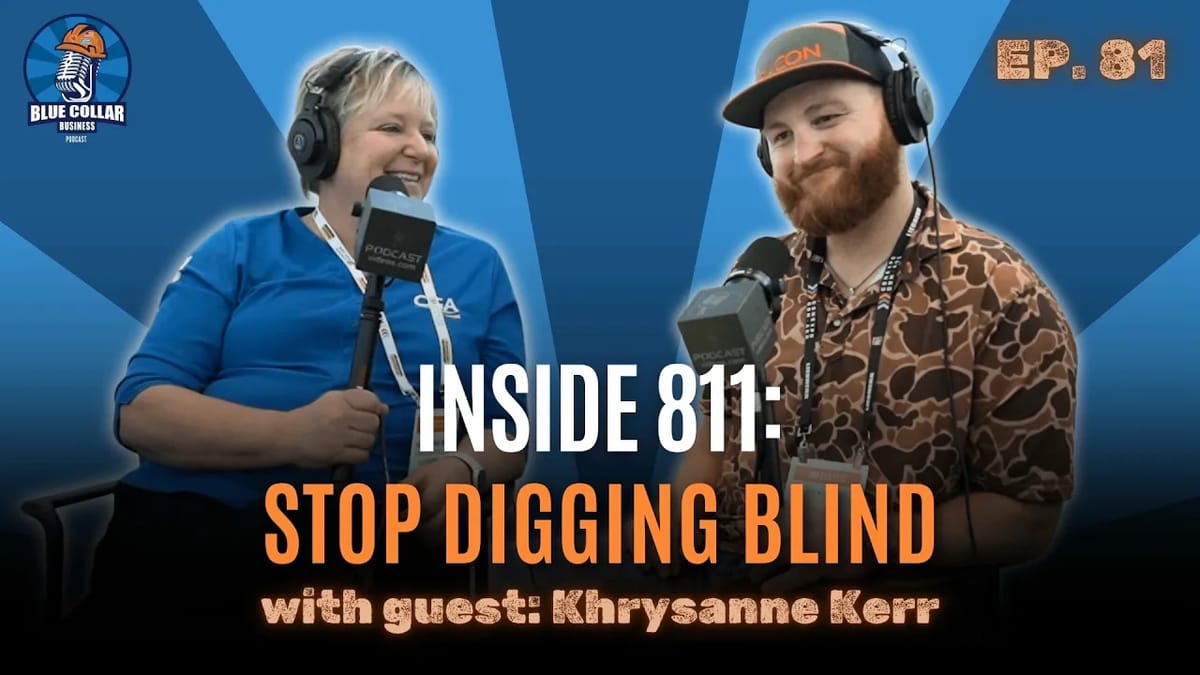
This episode was filmed live at Con Expo in Las Vegas! Join us for this special episode with Khrysanne Kerr!
A locate mark that’s a few feet off can wreck a schedule. A utility strike can change a life. That’s why we sat down with Khrysanne Kerr from the Common Ground Alliance, one of the leaders behind the nationwide 811 Call Before You Dig campaign, to talk through what’s actually happening inside the locate system and what contractors can do to make it work better.
We get into the real numbers that most people never think about: at any given time there can be more than one million active 811 locate requests across the country, but the locating workforce doesn’t magically scale with your deadline. Khrysanne explains why ticket volume keeps rising as more infrastructure goes underground and funding expands projects, and we share the simplest way to reduce waste: only request locates for the work you’re truly ready to dig. If you’ve ever wondered why marks show up late, incomplete, or rushed, this part connects the dots.
From there we go practical. We talk about white lining with white paint or flags, why professional locators overwhelmingly say it’s the biggest damage prevention lever, and how it protects both the locator and the excavator through clearer communication and better documentation. Khrysanne also points you to free online excavation training from the Common Ground Alliance with 30+ modules in English and Spanish, built for crews who need training that fits real job-site life. We wrap with the hard truth about mis-marks, aging records, and why better mapping, GIS data, and new technology (from drones to smarter excavation equipment) will shape the future of underground utility locating and excavator safety.
If you get value from this, subscribe to the show, share it with your crew, and leave a review so more contractors find the info that keeps people safe.
Tune in to the Blue Collar Business Podcast with Sy Kirby for the rawest, most relevant stories behind building a successful business in the trades. New episodes drop every Wednesday at 5 am CST—put your boots on and get ready to level up.
Follow and stay connected:
Never miss an update—follow, subscribe, and join the conversation!
More About this Episode
Digging Blind: The 811 Truth No One Tells You
The world of underground utilities is a high-stakes game of inches, and quite frankly, it’s one where the cost of a mistake isn't just measured in dollars, it’s measured in lives. As a contractor, I’ve spent years in the trenches, literally and figuratively, learning through trial, error, and a whole lot of money. One of the biggest pain points we face every single day is the locate process. We’ve all been there: staring at a job site, waiting for the 48-hour window to close, wondering why the paint isn't on the ground yet, or worse, looking at a mismark that’s three feet off.
I recently sat down with Khrysanne Kerr from the Common Ground Alliance. She is someone who actually helped build the 811 campaign, and having her perspective, the national head of the system we use in all 50 states, is a game changer for those of us on the business end of a shovel. We talked about the efficiencies we need as contractors, the pressure on the 811 system, and the practical steps we can take to ensure our crews go home safe every night.
The Hamster Wheel of Locate Requests
One of the most staggering statistics Khrysanne shared is that at any given moment, there are more than one million active locate requests nationwide. Think about that for a second. While you’re driving to your job site, there is a massive, invisible infrastructure of locators trying to manage an escalating volume of tickets with a workforce that remains relatively stable.
The underground is getting crowded. With new infrastructure funding pouring into rural America, the demand for digging is at an all-time high. But here is the truth: we, as contractors, are sometimes our own worst enemies when it comes to the "hamster wheel" of tickets. We get into the habit of calling in a month’s worth of work or a 30-mile project all at once, even though we know we physically cannot get to it all in the next 48 hours. When we do that, we create waste in the system. We bury the locators in paperwork for jobs that aren't immediate, which delays the locates for the jobs we actually need to start today. It’s about ticket discipline, calling in only what you are going to work on this week so the locators have a fighting chance to be accurate and on time.
The Power of White Paint
If you want to move the needle on efficiency, we have to talk about white paint. I’ll admit, for years I was guilty of thinking, "They’ll figure it out," and I’d just call in the ticket without marking the site. But that is a recipe for an incomplete ticket or a mismark.
Khrysanne pointed out that 99% of professional locators agree that "white-lining,” putting down white paint or white flags in the specific area you plan to dig, is the number one way to reduce damages. If you’re putting in a single flagpole in the middle of a two-square-mile convention center, don't make the locator walk the entire property. Circle the spot. Throw an arrow down. When that locator shows up and sees exactly where you intend to break the surface, they can focus their attention on the critical lines in that specific zone. It protects their time, your time, and most importantly, your crew. It allows them to "read the earth" and the paint simultaneously, catching those extra service lines or pedestals that might not show up clearly on an outdated map.
Training for the Near Miss
In ten years of underground utility work, my team has only hit two gas lines. I’m proud of that record, but when that second hit happened, it was a wake-up call. We did our due diligence, we turned ourselves into the public safety commission, and we realized that you can never be over-trained. The guy on your site who thinks he knows everything is usually the guy who is going to get someone hurt.
811 offers a treasure trove of information that many contractors don't even realize is available. For example, in many states, there is a documentation process on the 811 website that acts as a "receipt" after a ticket is cleared. This kind of documentation is vital. As I always say, it’s not about the work you can do; it’s about the work you can document you’ve done. If you didn't document it, it never happened.
Beyond the paperwork, there is a massive resource of free online excavation training available at Common Ground Alliance. We’re talking about 30 different modules in both English and Spanish that your team can take during a rainout or a gap in the action. I’ve started making this a part of our monthly culture. We do breakfast for the crews, we talk housekeeping, and then we dive into these modules. It’s one thing to hear a safety talk; it’s another to have to teach the knowledge back to the group. That’s the level of learning that sticks.
The Mapping Struggle and the Future of Locates
We all deal with the frustration of mismarks. "It was three feet off" is a common refrain in the field. The reality is that much of our underground infrastructure is decades old, and the record-keeping hasn't always kept pace. In some older cities, you’re still dealing with wooden water mains or legacy lines that were never properly documented. When the guy who’s been with the city for 25 years retires, his "legacy of knowledge" often retires with him.
We need to move the needle toward universal mapping. While there is often a lack of willingness between entities to share their data, the technology is already here. Between drones, autonomous unmanned planes, and intelligent excavators that are designed to stop before they hit a pipe, the tools are evolving. But technology only works if the data is accurate.
We have to be our own best advocates. This means pushing for better contracts that allow locators to effectively mark their workload and ensuring that "as-built" documentation is submitted every time a change is made. We’re currently in a transition from the boardroom to the courtroom, and following best practices isn't just about safety, it’s about legal protection.
Dealing with the Unexpected
No matter how much you plan, the underground is full of surprises. I remember a project where we had to cross a 900 psi steel liquid petroleum line. That is a "big boy" line that feeds fuel to entire regions. We followed every step, had the representative on-site, and moved with extreme caution. But even then, we uncovered a two-inch bore rod duct-taped to a water line right above the petroleum main. It was an old, abandoned utility that wasn't on any map.
That moment reinforced why the system exists. We had to shut down until we knew exactly what we were looking at. My worst nightmare is a scratch or a hole that leads to a fire or an explosion on my watch. If you find something oddball underground, stop. Use the representative. Go through the steps. The 811 system only works if we do. It’s a galvanized effort that has already reduced damages to the nation’s infrastructure by 50% over the last decade, but there are still several hundred thousand utility damages every year. We have to close that gap.
Building a Culture of Safety First
At my company, our core values are Family First and Safety Drives Excellence. Every single thing we do as underground utility contractors is essentially unsafe if you aren't thinking with a safe mind. 811 is like 911, it is a critical service that manages the lifeblood of our schools, hospitals, airports, and homes.
As we look toward the future, the focus has to remain on awareness and use. We need to be active, engaged, and willing to have these hard conversations between contractors and locators. Whether you’re building a multi-mile pipeline or just sticking a fence post in the ground, you have an obligation to protect the infrastructure and ensure your guys get home to their families every single night.
The low-hanging fruit of damage prevention is gone. The next 50% of improvement is going to come from better documentation, better mapping, and a relentless commitment to training. Let’s keep digging, but let's stop digging blind.
Member discussion: