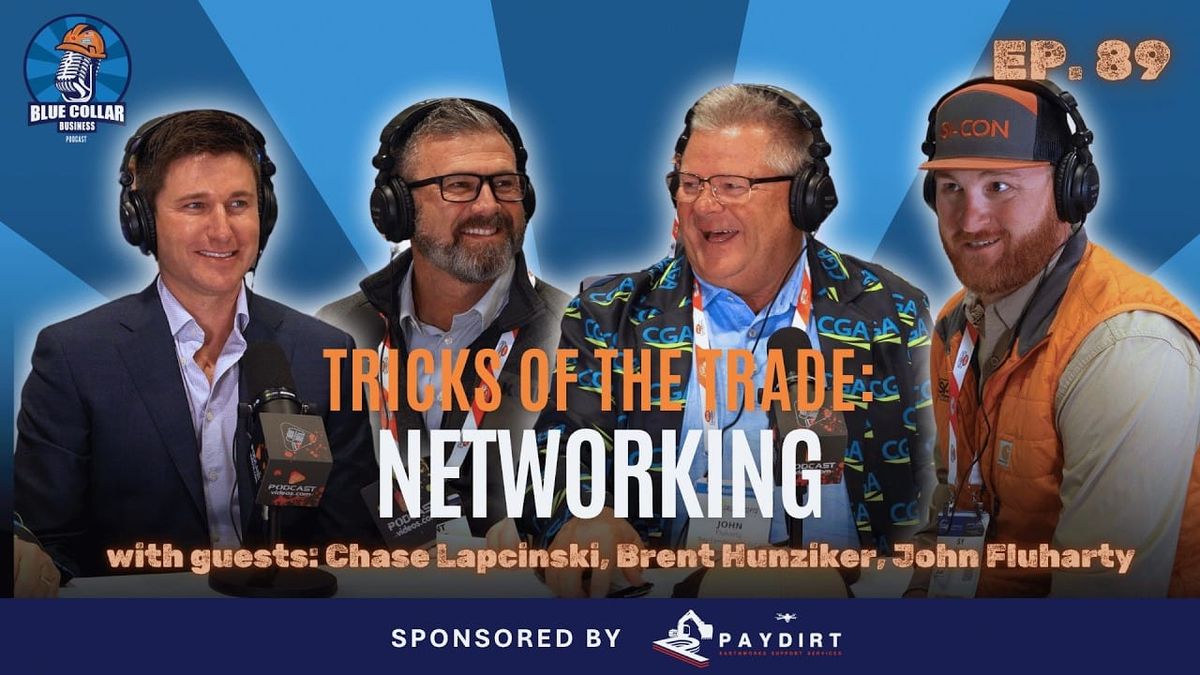
Utility strikes are more than just a production delay; they are a massive financial liability and a significant threat to crew safety. For years, the people actually doing the digging were left out of the policy-making rooms, resulting in a system where locators and excavators often operate at odds. We sit down at the Common Ground Alliance (CGA) conference to discuss how the "boots on the ground" are finally taking a seat at the table to overhaul damage prevention.
We get into the technical and tactical substance of what is actually happening in the trenches with John Fluharty, Chase Lapcinski, and Brent Hunziker. This conversation covers the high failure rates of current locate software, the necessity of "safe harbor agreements" for sharing utility mapping, and why the industry is pushing for specific line items for potholing in civil contracts. We also explore the unique role of DPAC in lobbying for better legislation and why the "missing middle" of communication between owners and contractors is causing 40 distinct points of failure on a single job site.
The unglamorous truth is that our industry currently operates more on risk transfer than actual safety, with many utilities prioritizing low-bid locators over quality results. You will walk away from this episode with a clear understanding of the legal and financial traps inherent in the 811 system and a roadmap for how to document your work to avoid five-figure bills years after a project is completed.
If you care about crew safety, civil infrastructure, and protecting your bottom line from utility damages, you’ll get a lot from this. Please Subscribe and Share to help us get this message to more contractors across the country. What is the biggest hurdle you face when trying to get an accurate utility locate in your state?
More About this Episode
Beyond the Surface: Why Contractor Leadership is the Future of Damage Prevention
Utility damage prevention has historically been a conversation dominated by facility owners and locating companies. For years, the people actually turning the dirt were often the last ones invited to the table. However, my recent experience at the Common Ground Alliance (CGA) Conference with industry leaders like John Fluharty, Chase Lapcinski, and Brent Hunziker has made one thing abundantly clear: if we want to fix the systemic issues of utility strikes and project delays, contractors must lead the charge.
The stakes in our industry have never been higher. We are standing on the precipice of a historical infrastructure boom. Between the expansion of broadband across rural America and the massive reinvestment in aging water and gas systems, the ground is being opened at a scale we have never seen before. Without a fundamental shift in how we manage underground data and legislative advocacy, we are simply inviting more risk into an already dangerous profession.
Moving from Commodities to Professionals
One of the biggest hurdles we face is the commoditization of utility locating. For too long, the industry has operated on a low bid model. Facility owners often go for the cheapest possible locating contract, which inevitably leads to overworked locators, inaccurate marks, and a complete breakdown of trust between the excavator and the facility owner.
When a locator is pinched for time and resources, their accuracy drops. When accuracy drops, the contractor loses confidence in the system. This lack of confidence triggers a vicious cycle: contractors begin calling in "blanket" locates or over-extending their ticket requests just to protect their production schedules. This, in turn, floods the 811 system with more work than the locators can handle, leading to even more delays and inaccuracies.
John Fluharty hit the nail on the head when he noted that the excavation community must be in lockstep with locators. We need to stop viewing locating as a cheap commodity and start treating it as a professional service. If the industry continues to squeeze the budget of the person holding the paint can, the hidden costs of damages and downtime will continue to skyrocket. We are saving pennies on the contract but losing hundreds of thousands of dollars on the repair bills.
The Myth of the On Time Locate
One of the most startling realizations from our recent panel discussion was the discovery of "silent" late locates. On paper, many states show high compliance rates for 811 tickets being completed within the legal window. However, the reality in the field is often much different.
The current call center software often allows for a digital loophole. A locator or facility owner can trigger an "information request" that effectively resets the clock on a ticket. To the state regulators, that ticket looks like it was handled on time. To the foreman standing on the job site with a crew and a backhoe, it is a ten day delay on a three day ticket.
This lack of accountability is why data integrity is so crucial. We need more contractors involved in the CGA and local 811 boards to report these no shows and reloads. If the data does not show a problem, the regulators will not feel the pressure to fix it. We have to own our piece of the system by documenting every failure point, ensuring that the "40 potential points of failure" between a call and a completed job are narrowed down through better policy.
The Safe Harbor Solution for Mapping
If there is one thing that would make the industry safer tomorrow, it is better mapping. We have the technology today to know exactly where every pipe and wire is buried. Between GPS, drone mapping, and advanced GIS systems, the technical capability is there. So, why are we still digging in the dark?
The answer is liability. Utility owners are often terrified to share their maps because they are scared of their own legal departments. They worry that if they provide a map that is slightly off, and a contractor hits a line, the owner will be held liable for the damage.
To solve this, we need to move past the technical discussion and into a legal one. We need to fight for "Safe Harbor" agreements. A Safe Harbor agreement would allow facility owners to share their data in whatever format they have—even if it is not perfect—without the fear of being sued for inaccuracies. As Brent Hunziker pointed out, contractors can actually help build these mapping systems. As we dig and verify lines, we can feed that data back to the owners to "true up" their records. It should be a two way street, but that street is currently blocked by a legal wall that only legislative advocacy can tear down.
The Power of DPAC and Legislative Influence
For the smaller contractor, the idea of changing state law can feel impossible. You are focused on payroll, equipment maintenance, and getting the next job in the ground. You do not have the time to sit in statehouse hearings or lobby politicians.
This is where the Damage Prevention Action Center (DPAC) comes into play. DPAC is essentially the lobbying arm for our interests, focused 100% on damage prevention law. As John Fluharty explained, this is not about electing candidates; it is about protecting our crews from bad legislation.
In many states, large telecommunications companies or other major entities constantly push for exemptions to 811 laws. For example, there have been pushes to allow broadband "drops" to be installed with a shovel without requiring a locate. This is incredibly dangerous. The shovel is the number two cause of utility damage in our industry. When you are digging next to a house where gas, electric, and water lines all converge in a three foot area, "just using a shovel" is a recipe for a house explosion.
By joining organizations like DPAC, contractors can pool their resources to fight these exemptions. For a relatively small investment, a contractor gets a seat at the table and an entire legal team dedicated to ensuring that the laws in their state actually make sense for the people doing the work. If your involvement in DPAC prevents just one major damage or one week of downtime per year, it has paid for itself ten times over.
Mentorship and the Networking ROI
Beyond the laws and the maps, there is a human element to this business that cannot be ignored. For contractors in their first five years of business, the temptation is to stay in the trench and work through every weekend. But there is a massive return on investment in getting out of the field for a few days to attend conferences like the CGA.
The real education does not always happen in the formal sessions; it happens during the networking hours and the conversations between the booths. This is where you meet veterans like John Fluharty or Brent Hunziker who have already navigated the minefields you are currently walking through.
Building a network of peers allows you to learn the "tricks of the trade" that you cannot find in a manual. You learn how other companies are financially justifying potholing, even when it is not a line item in the contract. You learn how to handle a liability claim that shows up two years after a job is finished. You learn that you are not alone in your frustrations with the 811 system.
A Future Proof Career Path
As we look toward the future, the rise of Artificial Intelligence (AI) is at the top of everyone's mind. While many industries are looking at massive job replacements, the blue collar utility world remains one of the most future proof career paths available.
AI will certainly help us with mapping, ticket management, and risk analysis, but it will never replace the person in the seat of the excavator or the laborer in the trench. You cannot automate the repair of a 300 foot water main break in the middle of the night. You cannot replace the intuition of an experienced operator who "feels" a change in the soil before the bucket hits a line.
We need to convey this message to the next generation of workers. This is a high tech, high stakes, and high reward industry. By professionalizing the way we handle damage prevention, we aren't just making our jobs easier; we are building a safer and more sustainable industry for the people who will come after us.
Final Thoughts for the Modern Contractor
We have to stop being passive participants in the damage prevention process. We cannot just complain about late locates and inaccurate marks while sitting on the sidelines. We have to be the ones pushing for Safe Harbor agreements. We have to be the ones calling out the software loopholes that hide late locates. We have to be the ones investing in legislative advocacy through groups like DPAC.
As contractors, our behavior is driven by two things: the law and the contract. It is time we start influencing both. By working together with leaders like John Fluharty, Chase Lapcinski, and Brent Hunziker, we can shift the needle. We can move from a "risk transfer" culture to a true "safety culture" where everyone—from the engineer to the locator to the excavator—is working from the same map toward the same goal.
The ground is getting more congested every day. The technology is evolving. The infrastructure needs are growing. The question is: are you going to be a contractor who just reacts to the chaos, or are you going to be a leader who helps us find a better way forward? The seat at the table is open. It is time to take it.
Member discussion: