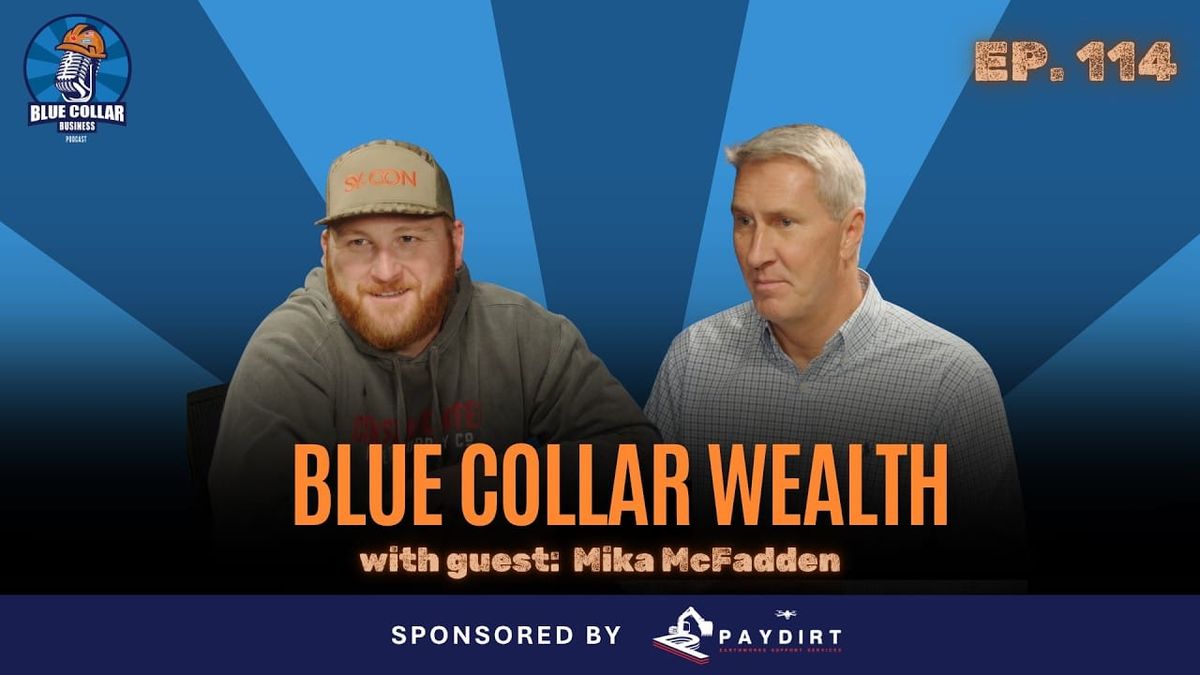
One bad injury can bankrupt a growing trades business. Mika McFadden breaks down how to protect your assets and retain A-players affordably.
We map out the exact mechanics of using alternative health plans, like ICRA, to keep top foremen from jumping ship. Mika explains how cash value life insurance acts as a secondary reserve.
This allows owners to borrow against their policies at simple interest for equipment purchases or unexpected cash flow crunches. You will learn to treat risk management as a foundational pillar for your heavy operations.
For mid-market contractors tired of losing talent due to weak benefit packages, this conversation outlines how to structure attractive insurance incentives. Subscribe and share this episode with a fellow trades owner looking to secure their company's future. What alternative benefits have actually moved the needle for your crew's morale?
More About this Episode
Building Generational Wealth and Risk Management Strategies for Blue Collar Businesses
The daily reality of running a blue collar business is an absolute grind. As contractors, builders, and tradesmen, we spend our lives bidding projects, managing specialized crews, and swinging the axe to build something that is designed to last a lifetime. We pour every single ounce of our blood, sweat, and capital into our operations. Yet, somewhere along the line, many entrepreneurs miss the absolute most crucial steps required to protect that very asset and the people who make the entire machine run. It is common to see young business owners operating entirely on workers compensation waivers, crossing their fingers, and simply hoping the absolute worst never happens. It is time to look at the stark reality of long term risk management, employee retention, and building actual generational wealth outside of just purchasing the next piece of heavy iron. Today, we are going to dive deep into the real strategies behind structuring employee benefits, the massive power of cash value life insurance, and exactly how you can solidify the financial foundation of your business for decades to come.
The Real Secret to Employee Retention in Construction
Attracting and keeping high performing individuals is arguably the single hardest part of the construction and trades industry right now. We all understand that paying a competitive wage is highly important, but a paycheck alone is simply no longer enough to secure the long term loyalty of an A-player. When you hire an exceptional employee, you are not just acquiring their labor for eight hours a day. You are directly impacting their entire family unit. The younger workers entering the labor force today are heavily focused on the security that comprehensive health, dental, and vision insurance provides for their spouses and their children. As an employer, providing that baseline security transforms your company from just another temporary job site into a permanent career destination. Think about it logically. If a prospective project manager or foreman is choosing between two companies offering the exact same base salary, but one provides a robust employee benefits package that protects his family, the choice becomes incredibly obvious. Offering benefits proves that you view your crew as human beings with real lives, not just disposable numbers on a payroll ledger.
Rethinking Alternative Health Insurance for Small Businesses
However, navigating the traditional health insurance market can feel like an impossible trap for small business owners. The costs are absolutely astronomical, the bureaucratic hoops are endless, and forcing a single rigid health plan onto a diverse group of employees rarely satisfies everyone. Fortunately, there are alternative health insurance options available that many contractors simply do not know exist. You do not have to settle for the traditional one size fits all major medical plan that drains your operating account every single month. One of the gaining trends in the market is the cost share plan, which operates a bit differently than standard insurance. In these plans, individuals pool their resources to share in medical costs after meeting a set annual contribution amount.
Another incredibly flexible option for small businesses is the Individual Coverage Health Reimbursement Arrangement, commonly referred to as an ICHRA or a choice plan. This program allows an employer to set a fixed, predictable monthly contribution amount for every single employee. The employee then takes that designated money to the open exchange and selects a specific health plan that perfectly fits their unique family needs. If a young, single worker wants a basic catastrophic plan, your employer contribution might cover the cost entirely. If an older worker with a family wants a premium, low deductible plan, they simply select it and pay the premium difference out of their own pocket. This choice based model completely removes the burden of you trying to play fortune teller with your team's medical needs. It scales beautifully whether you have three employees or thirty, giving you the ability to attract top tier talent without the crushing unpredictability of massive annual premium hikes.
The Entrepreneur's Safety Net with Cash Value Life Insurance
Protecting your employees is only half of the battle. You have to aggressively protect yourself and your family. Far too many entrepreneurs operate with the dangerous mindset that they are ten feet tall and bulletproof. I know exactly what that feels like because I started my own business the exact same way. I had no health insurance and no life insurance. I was just taking the world by storm and believing my hard work would magically fix any disaster. But if you have decided to be a lifelong entrepreneur, you must accept that you have chosen a life of constant, unavoidable risk. If a catastrophic accident takes you out of the picture tomorrow, what happens to everything you have worked so hard to build? What happens to your spouse, your kids, and the business that currently puts food on all of their tables? Letting your legacy end up tied up in a messy probate court is a financial nightmare you can completely avoid with proper planning, a solid trust, and the right permanent insurance policies.
When people hear the term life insurance, they often only think of standard term insurance. Term insurance is essentially renting a death benefit for a specific block of time, usually ten, twenty, or thirty years. It is incredibly useful for covering specific, expiring debts like a home mortgage or a college tuition fund. But when that specific term expires, the coverage ends and the money you paid into it is gone. Permanent life insurance, specifically cash value life insurance, operates in an entirely different financial universe. It is not a sunk cost or a monthly expense. It is a foundational asset that actively builds wealth.
To truly understand permanent life insurance, we have to look at the specific differences between whole life and indexed universal life. Whole life insurance is very much like the tortoise in the classic fable. It is incredibly slow, exceptionally steady, and constantly moving forward, usually offering a consistent, reliable dividend return year after year. Indexed universal life acts much more like the hare, but it comes built in with a massive, guaranteed safety net. Your returns in an indexed policy mirror a major market index like the S and P 500. When the overall stock market goes up, you capture those financial gains up to a certain percentage cap. But when the market inevitably crashes, your policy has a guaranteed zero floor. You never lose a single penny of your principal investment or your previously locked in gains due to stock market volatility. It acts exactly like a ratchet wrench that can only click upward and never slip backward.
The Power of Being Your Own Bank for Wealth Building
For a blue collar business owner, this unique financial structure opens up what professionals call the world of AND instead of the restricted world of OR. Most contractors take every available dollar of profit and dump it straight back into the business, constantly choosing between investing in their personal future or buying a brand new piece of equipment. Cash value life insurance allows you to effectively do both. When you build up significant cash value in one of these permanent policies, you can actually borrow against it to fund your own business operations. Unlike dealing with a traditional commercial bank that requires three years of corporate tax returns, months of detailed bank statements, and endless underwriting delays, accessing your policy cash value requires filling out a very simple form. Within just a few days, those funds hit your checking account ready to be deployed.
More importantly, when you take a loan from your cash value policy, you are typically charged a very low simple interest rate by the insurance carrier. But your actual capital remains inside the policy, still earning its full rate of return. If you have one hundred thousand dollars in cash value and you borrow fifty thousand dollars to buy a truck, your entire one hundred thousand dollars continues to grow in the market index. You are literally making your money work in two different places at the exact same time. You can use the loan to buy heavy equipment, fund a commercial real estate deal, or expand your shop operations, all while your foundational asset continues to compound. When it finally comes time to retire, these specific policies provide tax free income distributions. This allows you to completely bypass the massive tax burdens associated with traditional 401k withdrawals, where you are forced to pay ordinary income tax on every dollar you pull out during retirement.
The incredible advantages do not stop at retirement planning or death benefits. Modern permanent life insurance policies almost always include what are known as living benefits. If you suffer a major heart attack, a stroke, or a severe cancer diagnosis, you can actually access a large lump sum of your own death benefit while you are still alive. This critical injection of cash can offset massive medical bills, keep your business payroll funded, or just keep the lights on at home while you take the necessary time to heal. Furthermore, many of these policies include long term care provisions. If you can no longer perform basic daily activities like bathing or transferring yourself, the policy pays out monthly benefits. It is the absolute ultimate safety net for a family that completely relies on your physical ability to grind out an income.
Protecting the Operation with Keyman Insurance
Beyond your personal policy, you must also consider the structural integrity of your operation through Keyman insurance. Almost every successful construction company has that one vital superintendent, brilliant project manager, or highly skilled estimator who holds the entire daily operation together. If that specific person were to tragically pass away, the financial devastation to the company could be completely fatal. There are real world stories of key field operators falling from ladders or getting into fatal accidents, leaving the company scrambling to survive. A Keyman policy provides the business itself with a massive lump sum of tax free cash in the event of that key employee's sudden death. This capital allows the company to stay financially afloat, cover the immediately lost revenue, and take the appropriate time required to recruit and train a suitable replacement. It can also be utilized by surviving business partners to buy out a deceased owner's company shares from their grieving spouse. This ensures the business continues running smoothly without forcing an unprepared family member to suddenly take over a highly complex construction operation.
The Five Pillars of a Strong Financial Foundation
Building real, sustainable wealth and running a successful blue collar business requires immense daily discipline and a willingness to look far beyond the immediate daily grind. It is about deeply understanding that true stability comes from building a rock solid financial foundation first. If you want to survive the inevitable storms of entrepreneurship, you need to rely on what is commonly referred to as the five Fs.
First is Faith, providing the internal moral compass and strength to keep pushing forward when everything goes wrong. Second is Family, the very reason we take on this immense business risk and the people who stand by us through the highest peaks and the lowest valleys. Third is Friends, the inner circle of like minded individuals who will hold you accountable and lift you up when the heavy days eventually come. Fourth is Foundation, the financial safety nets, the legal trusts, and the permanent insurance policies we have discussed today that guarantee your legacy remains entirely intact. Finally, there is Flexibility, the crucial ability to adapt to new market conditions, embrace alternative financial strategies, and boldly pivot when the old ways of doing things no longer serve your ultimate growth. Take the time today to audit your life, audit your business finances, and get these critical protective pieces in place. Your future self, your dedicated employees, and your entire family will forever thank you for taking the risk management side of your business just as seriously as you take the physical work itself.
Member discussion: