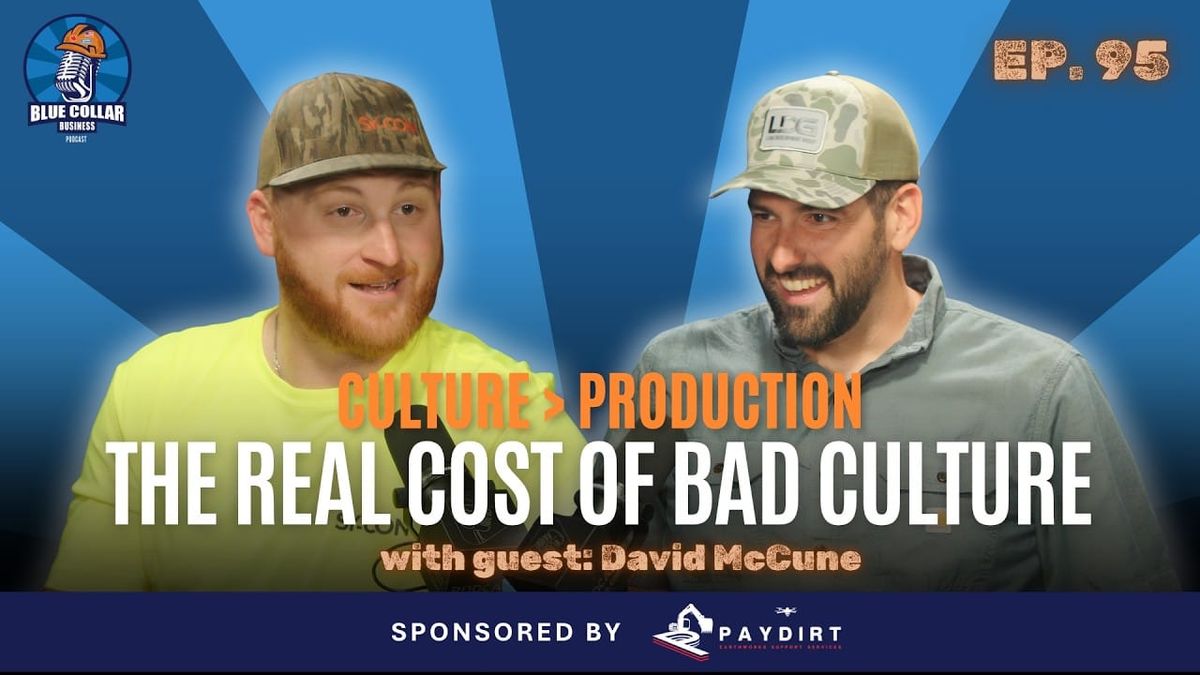
Chasing production while ignoring the people doing the work is a guaranteed profit leak. Right now, contractors are struggling to find and keep reliable help, constantly pointing fingers at the labor pool instead of looking at why their teams are turning over. David McCune, Vice President of Operations at Land Development Group, joins the show to share his boots-on-the-ground expertise on building teams that actually want to stick around for the long haul.
We sit down to unpack the real mechanics of building a functional workplace, stepping past the corporate buzzwords to focus on what actually works out in the dirt. The conversation hits heavy on prioritizing core values over raw output, dealing with toxic high producers, and establishing clear accountability metrics for superintendents and crews. David shares a pivotal mindset shift by reframing standard core values as "house rules," creating a baseline that is hard for anyone on the payroll to misunderstand or ignore.
Building a solid foundation means making some hard, expensive decisions, like letting go of the guy pulling the most footage because his attitude is a liability to the rest of the crew. You will walk away from this conversation with a clear understanding of the financial sting of high turnover, the direct link between crew chemistry and job site safety, and a firm check on your own leadership blind spots. Sometimes the bottleneck in your business isn't the market or the hiring pool, but the daily environment you have personally allowed to take root.
If you care about building a legacy company, reducing expensive turnover, and leading your crew with solid integrity, you’ll get a lot from this. Make sure to subscribe to the channel and share this episode with another contractor who needs to hear it. What is the hardest leadership habit you've had to break to improve your team's daily environment?
More About this Episode
The True Definition of Company Culture
In the blue-collar sectors, the word culture is often thrown around as a modern buzzword. It gets overcomplicated, over-cutified, and pasted onto office walls or corporate websites in the form of generic mission statements. But the truth about culture is much simpler, much grittier, and far more impactful than any corporate jargon.
Culture is quite simply what is normal.
Whether you are running a multi-crew excavation company, a small electrical shop, or standing under a shade tree fixing a tractor, you already have a culture. It exists in the way your team talks to one another, how they treat the equipment, what they do when a job gets messy, and what behaviors are allowed to slide. You have a culture whether you intentionally built it or not. The real question is whether you are running a healthy operation or letting a toxic environment quietly erode your bottom line.
A useful way to conceptualize this is to think of core values not as abstract ideals, but as house rules. When you rent a short-term property, the house rules are explicit: no smoking, no pets, no parties. If a guest breaks those rules, there is an immediate consequence, or they are asked to leave.
Your business requires the exact same clarity. When a team operates without explicit house rules, leaders are left navigating interpersonal issues with zero leverage. You find yourself dealing with an employee and realizing that something is completely off, that the individual is toxic or unmotivated, but you lack the objective vocabulary to address it. You end up shrugging your shoulders, telling yourself there is work to do, and moving on to the next crisis.
When you define the standards and live by them, individuals who do not fit the culture stand out instantly. Within a few weeks of hiring a new hand, the entire crew knows whether that person shares the company's core values or needs to be removed from the payroll.
Why Culture Drives the Bottom Line
There is a massive misconception in industry leadership that focusing on company culture is a soft, non-essential luxury that somehow detracts from raw output. Many owners operate under the rigid assumption that production must always sit above culture. They tolerate toxic high producers, aggressive field bosses, and cutting corners because they believe it is the only way to protect the numbers.
The reality of running a business tells a completely different story. When an organization prioritizes production over culture, it actually ends up choking its own capacity. Field production rate increases significantly when you shift your focus to the cultural health of the team.
Focusing heavily on production often yields less actual output than focusing on the people doing the work. When you care for the cultural items your team values, you create a unified focus. Everyone on the crew locks into the ultimate target: executing profitable, safe, and high-quality work every single day.
Consider the reality of field conditions. Underground utility work, concrete pouring, and commercial framing are brutal, unpredictable trades. Things go wrong constantly. You hit unexpected rock, utility conflicts stall the project, or a sudden storm turns a job site into a swamp.
When a team lacks a solid cultural foundation, a bad day turns into an absolute nightmare of finger-pointing, screaming matches, and intentional slowdowns. But when the culture is healthy, it carries the operation through the worst days.
You can walk onto a sloppy, freezing job site after 5:00 PM and find two hands laughing while cleaning thick mud out of the tracks of a mini excavator. They are not doing it because they love the task; they are doing it because they respect their teammates, respect the equipment, and accept the reality of the trade. A healthy culture builds structural resilience into an entire workforce.
The Financial Danger of Toxic High Producers
One of the hardest leadership tests an entrepreneur will ever face is dealing with a toxic high producer. This is the operator who lays more pipe, the foreman who pushes the crew harder, or the estimator who bids the most volume, but who simultaneously creates absolute chaos within the organization. They are arrogant, they treat the support staff poorly, and they actively ignore the core values of the business.
As an owner or executive, it is incredibly easy to justify keeping this person around. You look at their daily footage or their project metrics and tell yourself that they make your life easier. But behind the scenes, that single individual is quietly destroying your organizational reputation and driving your best utility hands out the door.
When a toxic high producer is allowed to operate outside the house rules, it signals to the rest of the company that the stated values are a complete lie. The crew sees that as long as someone moves dirt or hits a number, they can treat people like garbage. This completely destroys trust.
The moment you make the difficult decision to remove a culturally toxic high producer, something incredible happens. The system shifts. The low or mid-level performers who were being suppressed by that toxic individual suddenly find the room to step up.
A quiet, reliable team member who has been with the company for years might suddenly bloom into an exceptional field leader because they finally have an environment built on mutual respect. The culture itself drives the wrong people out and elevates the right people to the top.
Moving Beyond a Warm Body Hiring Policy
If a blue-collar business owner does not care about the human element of the workforce, they must still look closely at the raw math of employee turnover. Operating with a poor culture leads directly to a warm body hiring policy. This is the exhausting, unprofitable cycle where anyone with a pulse and a pair of steel-toed boots is thrown into a machine, only to quit or get fired three months later.
The cost of this constant churn is staggering. Losing an employee after one year instead of retaining them for two or three costs a business an estimated $10,000 to $20,000 per person in lost efficiency, recruitment, and onboarding costs. It takes months of training just to get a green laborer or a new apprentice to the point where they are actually making the company money rather than losing it through field mistakes.
Furthermore, high employee churn is a catastrophic field safety hazard. In heavy civil construction or commercial trades, safety relies entirely on team synergy. It functions exactly like a high-performing sports team.
When a crew works together for an extended period, the operators and laborers develop an unspoken language. The ground man knows exactly where the excavator operator is going to swing the boom; the trench tech knows the specific tendencies of the person running the box. They look out for one another automatically.
When you change the crew lineup every single week because people keep quitting, you destroy that synergy, compromise your field safety, and drastically increase the risk of a major field accident.
How to Rebuild Culture from the Top Down
Fixing a broken company culture requires an honest, often painful assessment from the founder or executive team. You cannot build a healthy, thriving company culture out of an unhealthy, checked-out heart. If you are stressed, angry, and viewing your workers purely as tools to pay off equipment debt, your team will smell that insincerity instantly.
The path to building a high-performing culture follows a distinct three-step process:
Leader Buy-In and Self-Accountability: The core values must live inside the owner first. They cannot be faked to increase profitability. If you claim that family first or safety drives excellence are core values, you must model that behavior every single day. When you make a mistake, you must own it publicly in front of the entire crew without making excuses.
Team Weigh-In for Genuine Buy-In: To get true alignment from the field, the team must have a voice in defining the standards. A practical approach is to gather the crew, present a broad selection of organizational value terms, and have everyone select the principles that truly matter to them. When the field hands actively choose values like grit, integrity, or craftsmanship, they take personal ownership of those rules.
Align All Administrative Decisions: Once the core values are set, you must hire, fire, promote, and reward based primarily on those principles, not just raw production. When your annual raises and promotion structures are tied directly to how consistently an employee embodies the company culture, the entire workforce understands that the house rules are absolute.
The Long-Term Perspective of Stewardship
At the end of the day, business owners are merely stewards of the people who walk through their doors. Employees do not belong to the company; they are free agents choosing to trade their time, sweat, and safety for a paycheck and a place to grow.
The goal of a truly great blue-collar organization should not be to trap people forever or to squeeze every single drop of labor out of them before they burn out. The true measure of leadership success is simple: Do people leave your company as better men and women than they were when they first walked onto your job site?
When you run an operation focused on building better people, the marketplace rewards you. High-quality field hands start recommending their friends and family. Your business builds a reputation for self-accountability and absolute integrity.
Even when a job goes sideways, a major blowout occurs, or a project misses a deadline, a culture of extreme ownership allows you to look the client in the eye, lay out the solution, and make it right without shifting blame. That is how you move past the daily chaos of survival, stabilize your workforce, and build a blue-collar business that lasts for decades.
Member discussion: