
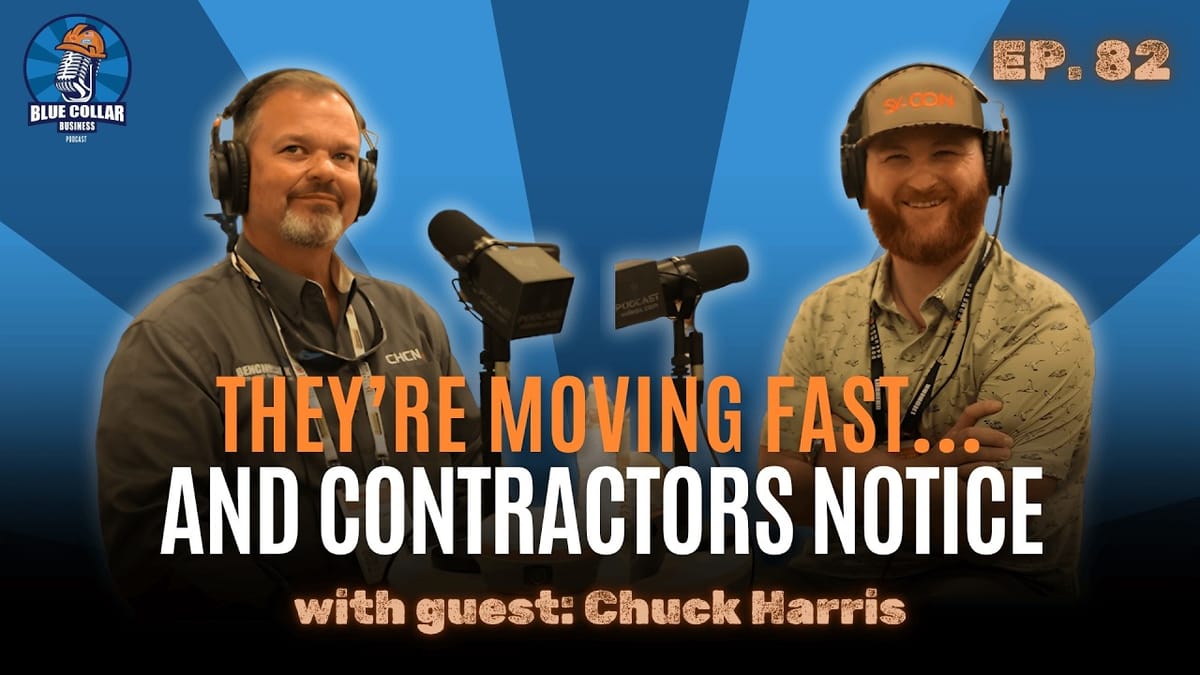
A lot of construction tech looks great in a demo and then dies on the jobsite. So we recorded this one live from ConExpo 2026 in the CHC Nav booth to talk about what actually sticks when crews are tired, the schedule is tight, and the boss wants ROI now.
Chuck Harris from Benchmark Tool and Supply breaks down what’s new with CHC Nav across GPS rovers, surveying, layout, and machine control. We get into the “visual stakeout” rover that uses forward and down-facing cameras to show a real-time image with your points and lines layered on top, making it easier for operators who don’t want to interpret a plan view all day. We also talk correction options, from UHF radio to cellular and RTK network workflows that can remove the need for an on-site base station on many jobs.
Then we jump to the LiDAR rover conversation: fast point cloud collection for stockpile volumes, safer measurement around demolition materials, and why that kind of speed changes decisions for project managers and owners. We also cover the TD73 dozer platform updates, better CAD performance, scalable system options, and a practical feature contractors love: the ability to move a display between machines without a license fee when something breaks or needs to be swapped quickly.
If you’re running excavation, grading, utilities, concrete, or even smaller residential crews and you’ve been burned by complicated GPS systems before, this talk is for you. Subscribe for more blue-collar business reality, share this with your foreman, and leave a review with the one feature you wish every piece of jobsite tech had.
Tune in to the Blue Collar Business Podcast with Sy Kirby for the rawest, most relevant stories behind building a successful business in the trades. New episodes drop every Wednesday at 5 am CST—put your boots on and get ready to level up.
Follow and stay connected:
Never miss an update—follow, subscribe, and join the conversation!
More About this Episode
The New Standard in Blue Collar Tech: Real Time Precision and Mass Market Adoption
For years the world of heavy construction and land development has been split into two camps. You either had the big outfits running high end GPS systems that cost as much as a luxury house or you had the guys still dragging chains and pulling tape because the barrier to entry was just too high. We have officially reached the turning point. Standing here at Con Expo 2026 the energy is different. The conversation has shifted from "can we afford this technology" to "how fast can we get it on every machine in the fleet" and that change is being driven by a relentless focus on simplicity and reliability.
When I started my journey in this business I spent a lot of money and even more time on trial and error. I took the hard road because the easy road didn't exist yet. But after spending the last few months digging into the CHC Nav ecosystem and working closely with the team at Benchmark Tool and Supply I can tell you that the game has changed. We are no longer in the early adopter phase where technology is a headache for the operator. We have entered the era of mass market adoption where tools are built for the guy in the seat and the owner looking for an immediate ROI.
Visual Stakeout and the Power of LIDAR in Your Hand
The rover is the backbone of any site. Traditionally you had a pole and a data collector and you spent your morning staring at a plan view trying to figure out which way was North while dodging site traffic. We have moved past that. The latest evolution in rovers like the i89 and the Benchmark F8 features dual cameras that provide a visual stakeout experience.
Imagine looking at your data collector and seeing a real time image of the site in front of you with a red line superimposed on the ground. You don't need to be a surveyor with thirty years of experience to follow a line on a screen. It guides you directly to your point and as you get closer it automatically toggles to a downward facing camera to show you exactly where your pole tip needs to land. This takes the guesswork out of the field and allows even the greenest crew member to be productive from day one.
Beyond just finding points we are now seeing LIDAR integrated directly into the rover. The Villy 100 is a prime example of where this industry is headed. It features a LIDAR sensor that collects over 800000 points per second just by walking. For years calculating stockpile volumes was a chore that involved dangerous climbing or tedious point collection. Now you can walk a circle around a pile of demoed concrete or a stack of base material hit stop and have a highly accurate volume report on your data collector in seconds. It is about safety it is about speed and most importantly it is about having the data you need to backfill or move material without waiting for a third party surveyor.
Breaking the Ecosystem Wide Open
One of the biggest pain points for contractors has always been the "closed loop" nature of technology. You buy one brand and you are married to that brand and their proprietary radios and their expensive service calls. That wall is coming down. The current generation of rovers features integrated UHF radios and cellular capabilities. You can talk to a traditional base station or you can run off a nationwide network like the Benchmark CPC. If you have enough cell signal to send a text message you have enough signal to achieve survey grade accuracy without even setting up a base station on site. This alone cuts your support and setup time in half.
We are also seeing a massive shift in how machine control hardware is managed. The new TD73 dozer platform is a testament to the idea of a universal ecosystem. In the past if an operator damaged a display on a Friday afternoon your machine was down until a replacement arrived and was licensed specifically for that unit. Now we are moving toward swappable hardware. The same display can run an excavator a motor grader or a dozer. You can pull a screen from one machine plug it into another tell it what machine it is on and be back to work without a license fee or a specialized technician.
Simplicity as a Business Strategy
I often say that simplicity pays. As an owner you cannot afford to have a hundred thousand dollars worth of technology sitting in a box because your operators find it too confusing to use. The hurdle has always been the complexity of the software—hidden menus buried channels and calibration routines that require a degree in engineering.
The feedback I am getting from the field on systems like the Easy Nav is consistent: it is just four buttons. Whether you are a residential concrete guy doing a house pad or a commercial contractor doing mass grading the tool has to be accessible to both the older demographic and the younger tech savvy generation. We recently had an experience where a cable was damaged on site. In the old days that meant a service call and a recalibration. With this new generation of tech it was a simple plug and play replacement. No recalibration was needed and the machine was back in the dirt for less than a hundred dollars. That is the kind of serviceability that keeps a business profitable.
Scalability for the Solo Operator and the Large Fleet
There is a common misconception that GPS and machine control are only for the big boys. The reality is that the ROI is often faster for the smaller guy. If you are a solo operator or running a small crew the ability to create a design on site validate your drainage and execute the grade in minutes rather than hours is a competitive advantage that cannot be overstated.
These systems are now designed to be scalable. You can start with a single mast system or even a manual setup and add sensors or dual mast capabilities as your business grows. You aren't cannibalizing your initial investment; you are building on it. This allows a contractor to adopt the technology today and stay current as new platforms are released without having to trade in their entire suite of tools every two years.
The Education of the Industry
Our priority has shifted from just selling equipment to educating the market on what is actually possible. The technology is moving so fast that most contractors don't even realize the tools they were wishing for five years ago are now sitting on a shelf ready to go. From aquatics and dredging to precision layout the breadth of what can be accomplished with a streamlined digital workflow is mind blowing.
The excitement we see at events like Con Expo is a reflection of a hungry industry. Contractors are tired of the old way of doing things—the slow way the expensive way. They want tools that work as hard as they do. By focusing on cost effective reliable and easy to use systems we are finally seeing the "blue collar" side of the business catch up to the digital age. It isn't about the gadgets; it is about the dirt moved the hours saved and the accuracy that keeps you from having to do the job twice.
The wildfire of adoption we have seen over the last few months is just the beginning. As more guys get these rovers and machine control systems into the field the gap between those using tech and those still doing it by hand is going to widen. My advice to anyone sitting on the fence is to do the research. Look at the speed of development and look at the support structures being built. The barrier to entry has never been lower and the potential for growth has never been higher.
Building a blue collar business is about expanding your toolbox. Whether you are under a shade tree or wearing a hard hat today the most powerful tool in that box is the one that gives you a clear picture of the ground beneath your feet. The future of the industry is here and it is more accessible than ever before.

Member discussion: